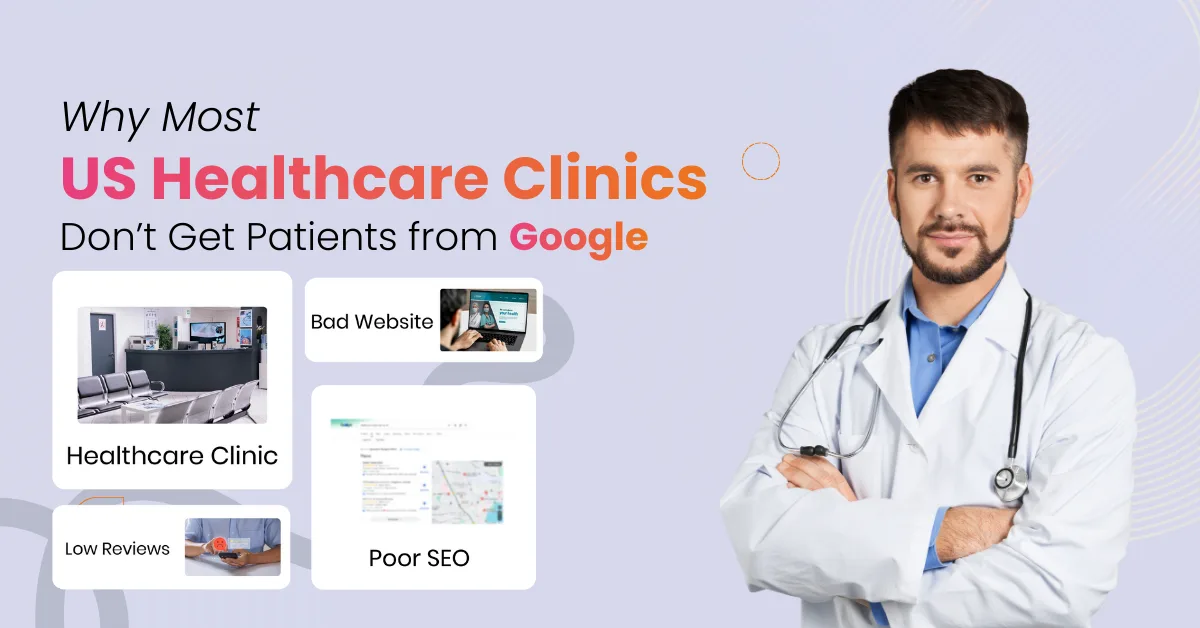
Many clinic owners believe that launching a website automatically brings patient traffic. Unfortunately, Google does not reward presence alone. Google rewards trust, relevance, accuracy, and patient intent alignment.
At Varun Digital Media, we audit healthcare websites and Google Business Profiles for clinics across the United States every day. Many clinics invest heavily in websites, ads, and directory listings, yet still struggle to generate appointments. In most cases, the doctors, treatments, and locations are not the problem.
The real issue is how Google evaluates the clinic’s digital credibility and consistency.
This guide explains why most US healthcare clinics don’t get patients from Google, what silently blocks visibility, and how a compliant healthcare SEO strategy attracts high-intent patients ethically and consistently.
Why Most US Healthcare Clinics Don’t Get Patients from Google (Quick Answer)
Most US healthcare clinics fail to get patients from Google because their websites and listings lack trust signals, intent-based content, and local SEO consistency. Google prioritizes clinics that demonstrate verified medical credibility, accurate business data, strong local relevance, and patient-focused content aligned with how people search for care.
Table of Contents
The Reality of Healthcare Competition in the United States
Healthcare competition is no longer local. Every clinic now competes digitally, even when patients search nearby.
A single local Google search can surface:
- Large hospital networks with national authority
- Urgent care chains dominating Google Maps
- Healthcare directories ranking above clinics
- Telehealth brands backed by full SEO teams
Google compares digital trust signals, not intentions. A clinic may provide excellent care, but if its online signals are weaker than competitors’, visibility drops—often without warning.
Why Competition Feels Overwhelming for Clinics
Google compares clinics based on digital signals, not intent. Strong local SEO relevance—including proximity, categories, and consistent business information—often determines whether a clinic appears in Maps or disappears beneath competitors.
Google prioritizes clinics that demonstrate:
- Consistent clinic information across platforms
- Strong local SEO relevance
- Active patient engagement signals
- Trustworthy and accurate medical information
If competing clinics perform better in these areas, your clinic can disappear from search results—even within the same neighborhood.
Why Most Clinics Never Appear on Page One
Ranking on Google is not random. Clinics fail to rank because their websites and listings do not align with how patients actually search.
Most healthcare searches are:
- Location-driven
- Treatment-specific
- Urgency-based
- Trust-focused
When clinic content does not reflect this intent, Google deprioritizes it.
Common ranking barriers include:
- Weak intent-based healthcare content
- Poor internal linking structure
- Slow-loading medical websites
- Mobile usability issues
- Inconsistent SEO execution
Google rewards clinics that stay accurate, active, and consistent over time.
How Google Interprets Patient Intent in Healthcare Searches
Google does not treat healthcare searches like standard business searches. Patient intent is evaluated more carefully because medical decisions involve safety, trust, and urgency.
When a patient searches online, Google analyzes:
- The urgency of the query
- The clarity of treatment intent
- The credibility of available medical information
- The consistency of clinic data across the web
For example:
- “Urgent care near me” prioritizes proximity, hours, and verified listings
- “Best orthopedic clinic” prioritizes reviews, expertise, and authority
If a clinic’s content does not clearly map to these intent patterns, Google quietly reduces visibility—even if the clinic is legitimate.
The Most Common SEO Mistakes Clinics Make
Many clinics unknowingly harm their Google visibility by following outdated or generic SEO advice.
The most common healthcare SEO mistakes include:
- Ignoring Google Business Profile optimization
- Using generic landing pages without treatment intent
- Publishing thin medical content without trust signals
- Inconsistent address and phone number data
- No review response or engagement strategy
Google requires clarity. When clinic information varies across platforms, Google loses confidence—and patients never find the practice.
Why Thin Medical Content Fails in Google Rankings
Healthcare content falls under Google’s YMYL quality standards, which require accuracy, expertise, and trustworthiness. Thin or promotional medical content fails to meet these expectations and is often suppressed in search results.
Thin medical content usually:
- Lacks clear treatment explanations
- Avoids credentials or author authority
- Uses generic marketing language
- Fails to answer patient questions directly
Google favors content that explains medical services in a clear, educational, and trustworthy way. Clinics relying on short, promotional content often lose rankings to more informative competitors.
Depth builds trust. Trust builds rankings.
Why Google Business Profile Controls Patient Discovery
According to Google, local search ranking factors such as relevance, distance, and prominence determine which clinics appear in Maps and local results. Accuracy and consistency directly affect whether a clinic is shown or suppressed.
Google Business Profile is one of the strongest ranking factors for healthcare clinics because it powers Google Maps and local search results.
For many clinics, Google Maps drives:
- Phone calls
- Direction requests
- Appointment inquiries
Google Maps prioritizes clinics that show:
- Accurate address and location consistency
- Correct treatment and service categories
- Active review engagement
- Updated photos and clinic details
Why clinics disappear from Google Maps (critical insight)
Clinics are commonly suppressed due to:
- Primary category mismatches
- Missing or outdated treatment listings
- Low review velocity despite high review counts
- Conflicting directory data
When Google cannot confidently verify relevance and accuracy, visibility is reduced silently.
How Directory Listings Influence Google Trust
Google cross-verifies clinic information using third-party directories.
These include:
- Healthcare listing platforms
- Local business directories
- Mapping and data aggregators
Even small mismatches in name, address, or phone number reduce confidence and suppress visibility. This is why clinics with strong reviews sometimes disappear unexpectedly.
Consistency is foundational—not optional.
Real-World Clinic Scenario (Experience Signal)
A mid-sized outpatient clinic had over 140 reviews but stopped receiving calls. The issue was not reputation.
The primary category did not match actual services, and directory addresses conflicted with Google Business Profile data. Once corrected, Google Maps visibility recovered within weeks—and appointment calls returned.
This is how Google evaluates clinics: through verification, not intention.
Why Paid Ads Stop Working Long-Term for Healthcare Clinics
Many clinics experience declining returns from ads over time. Industry data on rising healthcare advertising costs shows how competition drives CPCs higher, making paid visibility harder to sustain without organic SEO support.
Paid ads often deliver early traffic, but results decline over time.
Clinics relying heavily on ads face:
- Rising competition costs
- Lower patient trust than organic results
- Visibility that disappears when budgets stop
- Increasing compliance pressure
Ads vs Organic SEO Reality
| Factor | Paid Ads | Organic SEO |
| Cost stability | Unpredictable | Predictable |
| Patient trust | Lower | Higher |
| Long-term visibility | Stops instantly when ads pause | Compounds over time |
| Compliance risk | Higher | Lower |
| Google visibility | Temporary | Sustainable |
Ads without organic SEO create dependency—not growth.
How Organic SEO Attracts High-Intent Patients
Organic SEO connects clinics with patients already searching for care—not browsing.
Examples of intent-driven searches include:
- “Doctor near me”
- “Best clinic for treatment”
- “Healthcare clinic appointment”
Why organic traffic converts better
- Patients search for specific treatments
- Local SEO aligns with Google Maps
- Reviews build instant trust
- Clinics appear credible before contact
Organic SEO attracts patients ready to call, visit, or book.
What a Proper Healthcare SEO Strategy Looks Like
Healthcare SEO must be ethical, compliant, and patient-focused.
A proper strategy balances:
- Visibility
- Accuracy
- Trust
- Patient experience
Core components include:
- Optimized Google Business Profile accuracy
- Location-specific service pages
- Clear and trustworthy medical content
- Review generation and response workflows
- Technical SEO compliance
SEO done correctly builds credibility first, rankings second, and patient acquisition third.
Why Google Trusts Some Clinics More Than Others
Google behaves like a cautious patient. It avoids recommending clinics without strong trust signals.
Key trust indicators include:
- Doctor’s credentials clearly displayed
- Consistent clinic address everywhere
- Active responses to patient reviews
- Accurate treatment descriptions
- Professional website experience
Without these, visibility drops—even for legitimate clinics.
The Hidden Role of Website UX in Healthcare SEO
Google evaluates user behavior silently. Clinics should track patient actions such as calls, form submissions, and page engagement to understand whether their website experience supports patient intent and search relevance.
User experience is a silent ranking factor.
Google observes:
- Time spent on treatment pages
- Bounce rates
- Mobile navigation behavior
- Page clarity and layout
If patients struggle to find information, Google interprets this as poor relevance.
The Role of Reviews in Rankings and Patient Trust
Reviews influence both patient decisions and local SEO performance.
Clinics with strong review strategies:
- Appear more frequently in Google Maps
- Convert more patient calls
- Build long-term credibility
Ignoring reviews weakens visibility and trust.
Why Healthcare SEO Requires Long-Term Consistency
Healthcare SEO is not a one-time task.
Google expects clinics to:
- Update content regularly
- Respond to reviews consistently
- Maintain accurate listings
- Improve UX over time
Consistency signals legitimacy—something Google values deeply.
Ethical Growth Beats Aggressive Healthcare Marketing
Healthcare marketing must protect patient trust.
Ethical SEO focuses on:
- Accurate medical explanations
- Transparent clinic information
- Clear expectations
- Credibility over pressure
This builds sustainable growth and better patient outcomes.
Final Takeaway
At Varun Digital Media, we consistently see clinics struggle on Google—not because they lack expertise, but because their online presence lacks verification, structure, and intent alignment.
When clinics invest in ethical, compliant healthcare SEO, they gain sustainable visibility, stronger credibility, and more patients—without chasing ads forever.
See Why Your Clinic Is Not Ranking on Google
Get a personalized healthcare SEO evaluation to identify what’s blocking your clinic from ranking and attracting appointment-ready patients from local search.
Frequently Asked Questions (FAQs)
1. Why don’t most US healthcare clinics get patients from Google?
Most clinics lack optimized Google Business Profiles, consistent online information, patient-centric content, and active review management. These factors reduce their digital credibility, causing Google to rank them lower or suppress their visibility.
2. How important is a Google Business Profile for clinic visibility?
A complete and accurate Google Business Profile is crucial. It powers Google Maps and local search results, influencing phone calls, appointment requests, and directions. Optimizing categories, photos, and reviews boosts trust and ranking.
3. What role do patient reviews play in attracting new patients?
Patient reviews build trust and credibility. Clinics with steady, positive reviews appear more frequently in local search results and Google Maps, encouraging future patients to choose their services.
4. How can clinics improve their SEO to attract more patients?
Clinics should focus on creating location-specific, treatment-focused content that answers real patient questions, optimize their Google Business Profile, maintain consistent NAP (Name, Address, Phone) data across platforms, and actively engage with patient reviews.
5. Why does Google suppress some clinics from local search results?
Google suppresses clinics when their online information is inconsistent, categories are mismatched, or reviews are inactive. This lack of trust signals causes Google to reduce visibility despite the clinic’s quality of care.
6. Are paid ads a sustainable way to get patients from Google?
Paid ads can generate initial traffic but often lead to rising costs and lower patient trust over time. Organic SEO builds sustainable visibility, credibility, and patient acquisition without ongoing ad spend.
7. How does Google evaluate patient intent in healthcare searches?
Google analyzes urgency, treatment clarity, medical information credibility, and consistency of clinic data. Clinics that align their content with these factors rank higher and attract more high-intent patients.
8. What is the E-E-A-T framework and why does it matter for healthcare SEO?
E-E-A-T stands for Experience, Expertise, Authoritativeness, and Trustworthiness. Google prioritizes healthcare websites that demonstrate these qualities to ensure patients receive accurate and reliable medical information.
9. How often should clinics update their online content and reviews?
Consistent updates and regular engagement with patient reviews signal to Google that the clinic is active and trustworthy. Clinics should refresh content and respond to reviews frequently to maintain and improve rankings.
10. How can clinics ethically grow their online presence without pressuring patients?
Ethical growth focuses on providing accurate medical information, transparent clinic details, clear expectations, and respectful patient engagement. This approach builds long-term patient trust and sustainable SEO success.
Published: February 6th, 2026