A practical recovery guide for B2B SaaS brands
At Varun Digital Media, one question keeps coming up from SaaS founders and marketing teams:
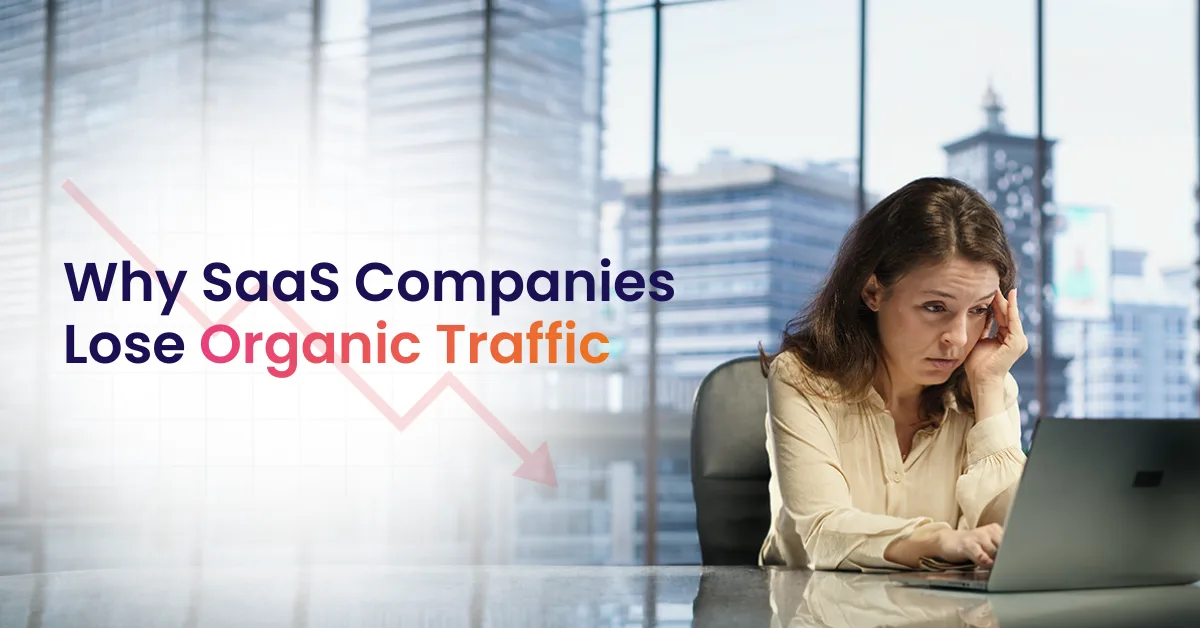
Why do SaaS companies lose organic traffic even when they keep publishing content?
You open Google Analytics. You see declining website traffic.
Search Console impressions flatten. Click-through rates drop.
Leads slow down. It feels sudden.
But losing organic traffic is rarely random.
It usually happens when site structure, content strategy, and search intent fall out of alignment with how users search and how search algorithms evaluate content.
In this guide, we will break down:
- Why SaaS companies lose organic traffic
- What causes organic traffic declines
- How AI overviews and zero-click searches impact clicks
- Why SEO vs product pages creates internal conflicts
- How to fix your SaaS SEO structure for long-term organic growth
This article is built for B2B SaaS decision makers. It aligns SEO strategy with demand generation and revenue growth.
Table of Contents
What Causes Organic Traffic Decline in SaaS?
Organic traffic declines when content structure, search intent, and technical SEO fail to match user behavior and modern search algorithms.
That is the short answer.
Now, let us go deeper.
1. Poor Site Architecture Weakens Search Visibility
Many SaaS companies scale quickly.
New features launch.
New landing pages appear.
Blog content multiplies.
But the structure becomes messy.
Search engines rely on clarity. If your SaaS website lacks a logical structure, organic search traffic suffers.
Common Site Architecture Problems
- Blog categories lack clear topical clusters and hierarchy.
- Product pages sit too deep in navigation layers.
- Internal links ignore core money landing pages.
- Duplicate feature pages confuse indexing signals.
- Structured data is missing on product sections.
When users search on Google, search engines evaluate authority and depth. If your structure does not demonstrate topical expertise, search visibility declines.
Google explains strong site structure principles clearly in its SEO Starter Guide.
Real Examples:
A B2B SaaS marketing automation platform had:
- 40 blog posts about marketing automation
- 6 feature pages targeting similar high-volume keywords
- 3 comparison pages competing for identical search queries
Inside Google Search Console, they saw:
- Flat search console impressions
- Fluctuating rankings
- Traffic decline on core landing pages
The solution was structural.
They consolidated overlapping blog post content.
They built dedicated landing pages by use case.
They improved internal linking across clusters.
They implemented structured data.
Within four months, organic search traffic recovered, and conversion rates improved.
Architecture protects organic visibility.
2. Keyword Cannibalization Confuses Search Algorithms
Keyword cannibalization happens when multiple URLs target the same target keywords.
Many SaaS companies publish aggressively. Over time, content overlaps.
Search algorithms struggle to determine which page deserves ranking priority. This reduces organic visibility across the domain.
Signs You Have Cannibalization
- Two URLs are ranking on page two simultaneously.
- Click-through rates are dropping for older pages.
- New blog post outranking the core product page.
- Search console impressions split across pages.
- Organic traffic declines without penalty notification.
This issue is common in B2B SaaS.
Example:
A project management SaaS company published:
- “Best Project Management Software”
- “Project Management Tools for Teams”
- “Online Project Management Platform Guide”
All targeted similar search volume keywords.
The result was fewer clicks and diluted search results positioning.
The fix required consolidation, improved E E A T signals, and clearer landing page mapping.
Google Search Console is essential for diagnosing cannibalization patterns.
When many SaaS companies ignore cannibalization, they slowly start losing traffic without understanding why.
3. Weak Content Mapping Breaks Search Intent Alignment
Search intent determines which page should rank.
Users search with different goals:
- Informational queries
- Commercial research
- High-intent transactional queries
If your content strategy fails to separate these clearly, traffic decline follows.
Strong Content Mapping Includes:
- Informational queries mapped to educational blog content.
- Commercial queries mapped to comparison landing pages.
- Transactional queries mapped to product landing pages.
- Structured data implemented for featured snippets eligibility.
- Internal links guiding users toward high-intent leads.
Many SaaS marketing teams accidentally create internal competition between SEO content and product pages.
SEO vs Product Pages: The Hidden Conflict
Here is where many SaaS companies lose organic traffic strategically.
They create:
- A blog post targeting a broad keyword.
- A product landing page targeting the same keyword.
Google must choose.
Often, it ranks the blog post.
Traffic increases.
Conversions drop.
Vanity metrics rise.
Revenue growth stalls.
Instead, your SEO strategy should look like this:
This structure protects organic search traffic and supports demand generation simultaneously.
4. AI Overviews and Zero-Click Searches
The search landscape has changed.
AI Overviews now answer many search queries directly within the SERP. Zero-click searches are increasing.
This results in:
- Fewer clicks
- Stable rankings but traffic drop
- Lower click-through rates
Understand how Google explains structured data and SERP features to implement them correctly.
Organic visibility today includes visibility inside AI summaries and featured snippets.
How SaaS Companies Should Adapt
- Optimize answers in short, clear definition blocks.
- Implement the FAQ schema for eligibility.
- Target long tail search queries.
- Focus on high-intent leads.
- Strengthen brand visibility beyond traditional search.
Organic search traffic now requires adaptation to modern search behavior.
5. Technical SEO Gaps Reduce Organic Growth
Technical SEO protects organic growth.
Common SaaS technical problems include:
- Slow page speed hurts user behavior signals.
- Duplicate metadata reduces search results clarity.
- Broken internal links are affecting crawl efficiency.
- Missing canonical tags are causing indexing confusion.
- Weakly structured data limits SERP features eligibility.
When organic traffic declines, analyze both Google Analytics and Search Console together.
Check:
- Indexed pages versus submitted pages
- Landing pages losing organic search traffic
- Changes in search console impressions
- Sudden traffic drop patterns
Technical SEO ensures long-term organic visibility.
6. Over-Focus on High Volume Keywords
High-volume keywords look attractive inside SEO tools.
But they often attract broad audiences.
Broad audiences mean:
- More traffic
- Lower conversions
- Weak customer lifetime value
Instead, B2B SaaS companies should prioritize:
- High intent leads
- Industry-specific landing pages
- Niche communities
- Long tail search queries
- Demand generation alignment
Organic growth must align with revenue growth.
More traffic does not always mean a better marketing strategy.
7. Weak E E A T Signals Reduce Brand Credibility
Search algorithms reward experience, expertise, authority, and trust.
If your SaaS website lacks:
- Author credentials
- Case studies
- Success stories
- User-generated content
- Expert insights
Organic visibility weakens over time.
Many SaaS companies invest heavily in paid search and Google Ads. Paid search brings quick results.
But organic growth builds long-term brand credibility.
Without authority signals, search visibility declines gradually.
Mini Case Study: SaaS Traffic Recovery
A mid-sized marketing automation platform experienced:
- 28 percent traffic drop in six months
- Falling search console impressions
- Lower click-through rates
Audit findings revealed:
- Cannibalized blog post content
- Poor internal linking
- Weak technical SEO
- Misaligned landing pages
Actions taken:
- Consolidated 12 overlapping blog posts
- Built 5 dedicated landing pages
- Improved structured data
- Strengthened E E A T signals
- Repaired internal linking
Within four months:
- Organic search traffic increased by 34 percent
- Conversion rate improved
- Higher quality leads increased
- Brand credibility strengthened
Organic traffic decline is reversible when the structure improves.
How to Fix Your SaaS SEO Structure
Follow this structured roadmap.
Step 1: Audit Search Queries
Use Search Console to identify overlapping search queries.
Step 2: Map Search Intent
Separate informational queries from transactional queries clearly.
Step 3: Consolidate Content
Merge duplicate blog post content targeting the same keywords.
Step 4: Improve Technical SEO
Fix crawl errors, indexing issues, and structured data gaps.
Step 5: Optimize for SERP Features
Structure answers for featured snippets and AI overviews.
Step 6: Build Authority
Add expert commentary, success stories, and proof-based content.
Step 7: Track Revenue Impact
Measure customer lifetime value from organic search traffic.
Organic growth must support demand generation and sustainable revenue growth.
Final Thoughts
Organic traffic does not disappear overnight.
When SaaS companies lose organic traffic, the cause is almost always structural. It may be site architecture. It may be search intent misalignment. It may be technical SEO gaps. Or it may reflect changes in the search landscape.
At Varun Digital Media, we focus on building SaaS SEO structures that protect organic search traffic long-term. The goal is not just more traffic. The goal is higher-quality leads, stronger brand visibility, and sustainable organic growth.
If you are losing organic traffic, do not panic.
Fix the foundation. Align your content strategy. Adapt to modern search behavior.
Maintain visibility across evolving search results.
Fix Your SaaS SEO Structure
Declining website traffic is not random. It reflects structural SEO weaknesses that can be corrected with clarity, precision, and strategic content mapping built for modern search behavior and evolving search algorithms.
Frequently Asked Questions
1. Why do SaaS companies lose organic traffic suddenly?
Many SaaS companies lose organic traffic due to weak site architecture, keyword cannibalization, poor search intent mapping, and technical SEO gaps. AI overviews and zero-click searches also reduce clicks even when rankings remain stable in search results.
2. How does Google Search Console help diagnose traffic decline?
Google Search Console shows search console impressions, click-through rates, and search queries driving organic search traffic. By analyzing trends, marketing teams can identify cannibalization, ranking drops, and indexing problems causing declining website traffic.
3. Are AI overviews causing SaaS companies to lose organic traffic?
AI overviews and other SERP features reduce clicks from traditional search results. However, visibility may remain stable. SaaS companies must optimize structured data, target featured snippets, and adapt content strategy to maintain visibility inside answer engines.
4. Should SaaS companies prioritize paid search over organic growth?
Paid search and Google Ads support short-term demand generation. Organic growth builds brand visibility, improves customer lifetime value, and delivers sustainable revenue growth. A balanced marketing strategy protects long-term organic search traffic.
5. What is the fastest way to recover from an organic traffic decline?
The fastest recovery involves auditing search intent mapping, fixing keyword cannibalization, improving technical SEO, consolidating overlapping content, and strengthening EEAT signals. Focus on high-intent leads rather than chasing only high-volume keywords.
Published: February 13th, 2026