
Reading Time: 5 minutes
Search engine optimization often feels overwhelming for business leaders and marketing managers. There are endless metrics, tools, and recommendations. Everyone talks about content, backlinks, technical SEO, and updates from Google. Yet, despite heavy investment, many websites see slow or inconsistent growth.
At Varun Digital Media, we work with growing businesses and enterprise brands that face the same challenge. They invest time, money, and teams into SEO, but only a small portion of those efforts actually drives revenue. This is where the Pareto principle, also known as the 80/20 rule, becomes a powerful lens for SEO strategy.
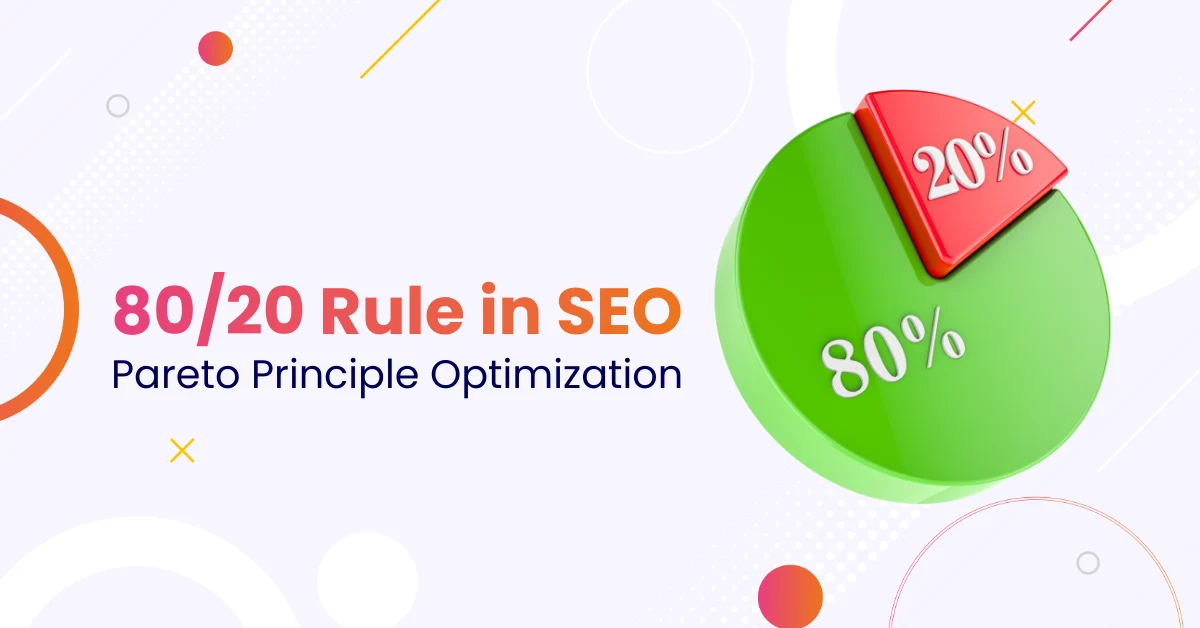
The 80/20 rule in SEO – Pareto principle optimization helps leaders focus on what truly matters. It removes noise. It aligns SEO with business impact, not vanity metrics.
Table of Contents
Understanding the Pareto Principle From a Business Lens
The Pareto principle comes from Italian economist Vilfredo Pareto, who observed that wealth followed an unequal distribution. Roughly 80 percent of the land was owned by 20 percent of the population. Over time, this pattern appeared in economics, management, sales, and marketing.
In simple terms, the 80 20 principle, Pareto states that a small percentage of inputs creates a large percentage of outputs. This idea applies perfectly to digital marketing and search engine optimization.
From a leadership perspective, this insight is critical. Most businesses do not fail because they do too little. They fail because they focus on too many low-impact activities while ignoring the few actions that move revenue and growth.
Why SEO Naturally Follows the 80/20 Rule
SEO is not evenly distributed. Google does not reward all pages, keywords, or backlinks equally. Instead, search engines amplify what already performs well.
When leaders analyze Google Search Console and Google Analytics, a clear pattern appears. A small percentage of pagesgenerates most organic traffic, conversions, and visibility in Google search results. The rest of the site contributes very little.
This is the uncomfortable truth of SEO.
Most SEO work does not move the needle.
Understanding this reality allows executives and marketing managers to design a smarter SEO strategy that prioritizes impact instead of effort.
How the 80/20 Rule Transforms SEO Decision-Making
For business leaders and digital marketing managers, the biggest SEO advantage comes from clarity. The Pareto principle forces teams to stop spreading efforts thin and start allocating resources where impact is proven. When applied correctly, this mindset improves rankings, conversions, and revenue without increasing workload.
SEO Areas Where the 80/20 Rule Creates Maximum Impact
| SEO Area | 20% Focus That Drives Results | Business Outcome |
| Content | Top performing pages and product pages | Higher organic traffic and conversions |
| Keywords | High-intent keywords with search volume | Faster ranking and qualified leads |
| Backlinks | High-quality backlinks from relevant websites | Stronger authority and trust signals |
| Technical SEO | Core Web Vitals and site speed fixes | Improved user experience and rankings |
| Internal Links | Strategic links from valuable pages | Better crawl flow and page authority |
This table shows why strategic planning matters more than activity. Leaders who focus on the right SEO levers consistently outperform competitors using the same resources.
How the Pareto Distribution Shows Up in SEO Data
| SEO Area | 20% That Drives Impact | 80% That Adds Limited Value |
| Pages | Top performing pages and money pages | Low traffic, unfocused pages |
| Keywords | High-intent, revenue-driven keywords | Informational or vanity keywords |
| Backlinks | High-quality backlinks from relevant sites | Low-quality links with no authority |
| Content | High-quality content answering search intent | Same content with little differentiation |
| Technical SEO | Core Web Vitals and crawl fixes | Minor cosmetic and technical changes |
For decision-makers, this table highlights a key insight. SEO growth is not about doing more. It is about doubling down on the right 20 percent.

The 80/20 Rule in Keyword Research and Search Intent
Keyword research is one of the most misunderstood areas of SEO. Many teams chase long keyword lists without understanding business value. However, search volume alone does not equal revenue.
From a digital marketing perspective, the 80 20 principle shows that a small set of keywords generates most sales, leads, and conversions. These keywords usually align with product pages, services, and buying intent.
Instead of expanding keyword lists endlessly, leaders should focus on keywords that:
- Directly support sales and revenue goals
- Align with buyer intent and conversion paths
- Already appear in Google search results positions eleven to thirty
Optimizing these keywords often delivers faster SEO results than creating new pages from scratch.
Content Creation Through the Pareto Lens
Content production consumes time, budget, and teams. Yet most content never ranks or drives traffic. This is where the 80/20 rule creates clarity.
In nearly every website, a few pages build topical authority and attract consistent organic traffic. These pages answer real user questions, align with intent, and satisfy search engines.
Publishing more content without a strategy leads to content dilution. Publishing focused, high-quality content leads to growth.
From a leadership view, the goal is not more blogs. The goal is content that supports business outcomes.
Why Top-Performing Pages Deserve Priority
Every website has top-performing pages. These pages already receive traffic, impressions, and clicks. Google already trusts them. That makes them the fastest path to SEO improvement.
When these pages are optimized correctly, results multiply.
Improving title tags, refining meta descriptions, strengthening internal links, and adding schema markup can significantly improve conversion rates and rankings without publishing new content.
For executives, this represents a high-ROI opportunity. These improvements require minimal effort compared to creating new pages, yet they often deliver outsized results.
Internal Links as a Strategic SEO Lever
Internal links are often overlooked by leadership teams. However, they are one of the most controllable SEO assets a business owns.
Strong internal links help search engines understand page importance. They guide authority from high-traffic pages toward valuable pages and money pages.
When internal linking is applied strategically, it improves crawl efficiency, ranking stability, and topical relevance. This is one of the most cost-effective SEO improvements available.
Applying the Pareto Principle to Link Building
Link building is another area where businesses waste resources. Chasing hundreds of links often leads to low-quality links that add little value and increase risk.
The Pareto principle shows that high-quality backlinks outperform volume. A few authoritative mentions, earned through digital PR and trusted websites, deliver stronger SEO signals than dozens of weak links.
From a management standpoint, this reduces risk and improves sustainability. Quality links strengthen brand authority, not just rankings.
Technical SEO and the 80/20 Focus
Technical SEO can appear complex, but the reality is simpler. Most ranking issues come from a small set of problems.
Fixing site speed, improving Core Web Vitals, resolving crawl issues, and ensuring mobile performance for mobile users address the majority of technical barriers.
Minor technical tweaks rarely produce meaningful SEO results. Strategic technical fixes do.
Moving Beyond Vanity Metrics Toward SEO Success
Many SEO reports focus on vanity metrics. Impressions, keyword counts, and traffic spikes look impressive but often fail to connect with revenue.
Business leaders should evaluate SEO based on metrics that matter:
- Organic traffic quality
- Conversion rates
- Revenue contribution
- Performance of product pages
This mindset aligns SEO with business goals instead of surface-level activity.
Why the 80/20 Rule Is Essential for Modern SEO Leadership
The SEO industry has matured. Competition is higher. Algorithms are smarter. Businesses that succeed understand that focus beats volume.
The 80/20 rule, Pareto’s principle, and Pareto distribution provide a framework for strategic planning. They help leaders allocate resources intelligently and align SEO with business growth.
SEO is no longer about doing everything.
It is about doing what matters most.
Final Thoughts: Focus Is the Real SEO Advantage
At Varun Digital Media, we help organizations apply the Pareto principle to SEO in a practical, data-driven way. We analyze what already works, remove distractions, and focus on actions that deliver measurable results.
The 80/20 rule in SEO Pareto principle optimization is not a shortcut. It is a smarter way to build sustainable visibility, authority, and revenue.
For business leaders, marketing managers, and digital teams, the message is clear.
Stop chasing noise.
Start focusing on impact.
That is how SEO moves from activity to advantage.
Apply the 80/20 Rule to Your SEO Strategy
Focus on high-impact SEO actions that drive rankings, revenue, and measurable growth using data-backed Pareto optimization.
Frequently Asked Questions
1. What is the 80/20 rule in SEO?
The 80/20 rule in SEO means that a small percentage of SEO efforts generates most results. Typically, a few pages, keywords, and backlinks drive most organic traffic, rankings, and conversions, as revealed through Google Search Console and Google Analytics data.
2. How does the Pareto principle improve SEO strategy?
The Pareto principle improves SEO strategy by helping teams prioritize actions that matter most. Instead of spreading resources across low-impact tasks, it focuses efforts on valuable pages, high-intent keywords, and technical fixes that deliver faster and more sustainable SEO results.
3. Can the 80/20 rule increase organic traffic faster?
Yes. By optimizing top-performing pages, improving internal links, and targeting high-converting keywords, the 80/20 rule helps increase organic traffic faster. This approach avoids unnecessary content production and focuses on actions that search engines already reward.
4. How does the 80/20 rule apply to link building?
In link building, the 80/20 rule shows that a few high-quality backlinks outperform many low quality links. Strong backlinks from relevant websites improve authority, rankings, and trust, while low quality links add little value and may harm SEO performance.
5. Why is the 80/20 rule important for business leaders?
The 80/20 rule is important for business leaders because it aligns SEO with revenue and growth. It reduces wasted effort, improves ROI, and ensures SEO investments focus on actions that move the needle instead of chasing vanity metrics.
Published: January 27th, 2026