Until very recently, SEO used to be a game of keywords.
Identify the right keywords, put them in the H1 title, add the keywords a few more times in the webpage or content, and wait for the rankings.
That still matters, but it is no longer enough.
The emergence of AI interfaces has changed the way people search on the internet. Accordingly, the search engines have also evolved. Now the search engines identify your brand by context, entities, products, services, topics, and the relationships between them.
That is where entity SEO becomes important.
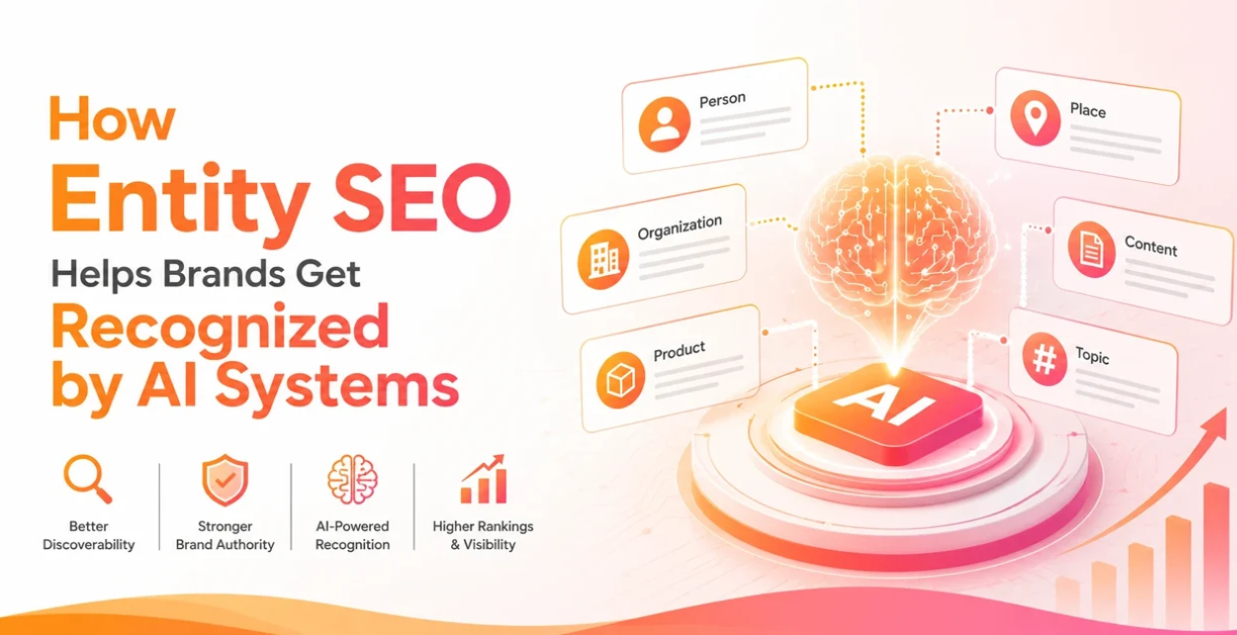
Entity SEO helps your brand become a clearly understood “thing” in search engines and AI systems. It tells Google, ChatGPT, Gemini, Perplexity, and other AI-led search platforms that your brand is not just a website with keywords. It is a real business connected to specific services, products, people, locations, topics, and expertise.
In simple words, entity SEO helps AI systems recognize your brand correctly.
Table of Contents
What Is Entity SEO?
Entity SEO is the process of helping search engines understand your brand, content, services, products, people, and topics as clear entities.
An entity is a real and identifiable thing.
It can be:
- A brand
- A person
- A product
- A service
- A location
- A business category
- A topic
- An industry
- A concept
For example, “Apple” can mean a fruit or a technology company. Search engines understand the difference by looking at context, relationships, and supporting signals.
If the content says Apple, iPhone, MacBook, Tim Cook, iOS, and App Store, Google understands that the entity is Apple the company, not apple the fruit.
That is the basic idea behind semantic entities SEO.
It is not about repeating the same keyword again and again. It is about building enough context so search engines understand exactly what you mean.
Why Entity SEO Matters More in AI Search
AI search has changed how users find information.
Earlier, people searched on Google, opened a few results, compared websites, and made a decision. Now, many users ask AI tools direct questions and expect a summarized answer.
For example:
“What is the best payroll software for manufacturing companies?”
“Which pediatric dental clinic offers emergency care near Annapolis?”
“What are the top VoIP providers for small businesses?”
AI systems do not simply match these questions with exact keywords. They look for trusted entities that are strongly connected to the topic.
That means your brand needs to be understood as part of a larger topic network.
If your brand sells payroll software, AI systems should connect your brand with:
- Payroll management
- Attendance tracking
- Leave management
- Salary processing
- Compliance
- Overtime calculation
- Employee records
- HRMS
- Manufacturing payroll
- Healthcare payroll
This is how entity based SEO supports AI visibility.
When your brand entity is clear, AI systems are more likely to include your brand in answers, summaries, comparisons, and recommendations.
Keywords Still Matter, But Context Matters More
Keywords are not dead. That line is often used for drama, but it is not true.
People still search using words. Search engines still need page titles, headings, URLs, anchor text, and body content. Keywords help match content with search demand.
But keywords alone do not build understanding.
A page can repeat “entity SEO” ten times and still fail to explain the topic properly. Another page may use the keyword fewer times but explain related ideas like knowledge graphs, structured data, schema markup, semantic search, brand mentions, and topical authority.
The second page gives search engines more meaning.
That is the shift.
Traditional SEO asks:
“Which keyword should this page rank for?”
Entity SEO asks:
“What should this brand be known for, and how do we make that clear everywhere?”
How AI Systems Recognize Brand Entities
AI systems look for patterns.
They try to understand how your brand appears across your website and the wider web. If the same brand is described consistently in multiple places, AI systems gain more confidence.
For example, if a brand is described as a payroll software provider on its website, Google Business Profile, LinkedIn page, software directories, guest posts, product pages, and reviews, the signal becomes stronger.
But if one profile says HR software, another says accounting software, another says workforce app, and the website gives no clear explanation, the brand entity becomes weak.
AI systems do not like confusion.
Clear entity optimization SEO removes that confusion.
It makes your brand easier to identify, classify, and connect with relevant topics.
The Role of Google Entity Recognition
Google entity recognition is the process of identifying things, people, places, brands, and concepts inside content.
For example, if Google reads a page about “Bharat Payroll,” it should understand:
- Bharat Payroll is a brand
- It belongs to the payroll and HRMS category
- It serves businesses
- It is connected to payroll, attendance, leave, compliance, and employee records
- It may be relevant for Indian businesses if the content explains Indian payroll needs clearly
That is much stronger than simply saying “payroll software” many times.
Google wants to understand the entity behind the keyword.
This is why brands need to make their identity obvious.
A strong brand entity usually answers these questions clearly:
- What is the brand name?
- What does the brand do?
- Who does it serve?
- Which services or products does it offer?
- Where does it operate?
- Which industry does it belong to?
- Which topics is it connected with?
- Why should it be trusted?
If your website does not answer these clearly, AI systems may struggle to describe your brand correctly.
Knowledge Graph SEO and Brand Recognition
Knowledge graph SEO is about helping search engines understand the relationships between entities.
Think of a knowledge graph like a map.
It connects different things together.
For example:
Bharat Payroll → payroll software
Payroll software → salary processing
Salary processing → compliance
Compliance → PF, ESI, PT, TDS
Bharat Payroll → attendance management
Attendance management → shift tracking
Shift tracking → overtime payroll
When these relationships are clear, search engines can understand your brand in a deeper way.
This matters because AI systems depend on connections.
They do not just ask, “Does this page contain the keyword?”
They ask:
“Is this brand strongly connected to this topic?”
“Is this brand mentioned in trustworthy places?”
“Does the website explain the topic deeply?”
“Do structured data and external signals confirm the same meaning?”
That is where a brand knowledge graph becomes useful.
A brand knowledge graph connects your brand with its services, people, products, locations, use cases, industries, and supporting content. It gives AI systems a cleaner picture of your business.
What Makes a Brand Entity Strong?
A strong brand entity does not happen because of one blog or one schema code.
It is built through repeated, consistent signals.
Here are the main elements.
1. Clear Brand Definition
Your homepage, About page, and service pages should clearly say who you are.
Weak version:
“We help businesses grow with smart solutions.”
Stronger version:
“Bharat Payroll is a payroll and HRMS platform that helps Indian businesses manage salary processing, attendance, leave, compliance, employee data, and workforce operations.”
The second version gives AI more useful information.
It defines the brand, category, audience, services, and market.
2. Consistent Business Information
Your brand name, address, phone number, logo, social links, founder details, and service descriptions should be consistent across platforms.
This includes:
- Website
- Google Business Profile
- YouTube
- Business directories
- Review platforms
- Press mentions
- Guest posts
- Partner pages
- Schema markup
Inconsistent information weakens entity trust.
Consistent information strengthens recognition.
3. Strong Topic Clusters
If you want AI systems to connect your brand with a topic, one page is not enough.
You need a cluster.
For example, a brand targeting entity SEO should not only publish one article on “entity SEO.”
It should also cover:
- Knowledge graph SEO
- Semantic search SEO
- Brand entity optimization
- Structured data
- Schema markup
- AI search optimization
- Entity based SEO
- Internal linking
- Topical authority
- Brand mentions
- SEO entities
- Content knowledge graphs
This builds topical depth.
The more complete your topic coverage is, the easier it becomes for search engines to understand your expertise.
4. Structured Data
Structured data helps search engines read your content in a machine-friendly format.
It can explain:
- Your organization
- Your logo
- Your website
- Your social profiles
- Your products
- Your services
- Your articles
- Your authors
- Your FAQs
- Your reviews
- Your locations
Schema markup is not magic, but it gives search engines clearer labels.
For example, if your page is about a service, Service schema can help define that service. If your page is a blog, Article schema can explain the headline, author, date, and publisher. If your website represents a business, Organization schema can connect your brand name, logo, URL, and social profiles.
This supports entity optimization SEO because it makes your brand and content easier to interpret.
5. Entity Linking
Entity linking connects important terms in your content to known entities.
For example, the word “Java” can mean a programming language, coffee, or an island. Search engines need context to understand which one you mean.
If the content mentions Java along with software development, backend systems, Spring Boot, and programming language, the meaning becomes clear.
Entity linking reduces confusion.
It helps AI systems understand the correct meaning of names, topics, tools, people, products, and places.
6. Internal Links That Show Relationships
Internal linking is not just about passing SEO value.
It also helps search engines understand relationships.
For example, a blog on “semantic search SEO” should link to pages about:
- Entity SEO
- Schema markup
- Knowledge graph SEO
- AI search optimization
- Topical authority
- Structured data
- Brand entity optimization
These links show how topics are connected.
Random internal links do not help much. Relevant internal links build meaning.
7. External Mentions and Brand Signals
AI systems also look beyond your website.
If your brand is mentioned on industry blogs, directories, review sites, podcasts, social media, comparison articles, and partner websites, those mentions help build recognition.
Backlinks are useful, but unlinked brand mentions also matter because they provide context.
For example, if multiple websites mention a company as a trusted provider of entity based SEO services, that repeated association helps search engines understand the brand’s category and authority.
This is why digital PR, guest posting, reviews, and thought leadership still matter.
They help build your entity outside your own website.
Entity SEO vs Traditional SEO
| Traditional SEO | Entity SEO |
| Focuses mainly on keywords | Focuses on topics, entities, and context |
| Optimizes individual web pages | Builds overall brand understanding across the web |
| Relies on exact search terms | Understands meaning, relationships, and user intent |
| Measures success through rankings and organic traffic | Also measures AI mentions, brand recognition, and knowledge graph presence |
| Depends on content and backlinks | Uses content, schema markup, brand mentions, backlinks, and entity signals |
| Helps pages rank higher | Helps brands become recognized and trusted by search engines and AI |
Traditional SEO is still useful. But entity SEO gives it a stronger foundation.
A page may rank for a keyword today and lose it tomorrow. A well-built brand entity can create more durable visibility because search systems understand what the brand represents.
Example: How Entity SEO Works for a SaaS Brand
Let us say a SaaS company offers an AI receptionist.
A normal SEO approach may target keywords like:
- AI receptionist
- AI answering service
- virtual receptionist AI
- AI phone receptionist
That is useful, but limited.
An entity SEO approach would go deeper.
The brand should connect itself with:
- Inbound call handling
- Appointment scheduling
- Lead capture
- Call routing
- Customer support
- Voice AI
- After-hours answering
- CRM integration
- Small business phone systems
- Healthcare call answering
- Dental office receptionist
- Real estate call answering
The website should include strong service pages, industry pages, FAQs, product schema, organization schema, customer use cases, internal links, and consistent external mentions.
Now AI systems can understand that the brand is not just targeting “AI receptionist” as a keyword. It is part of a larger business communication category.
That is the real value of entity SEO.
How Brands Can Start With Entity SEO
Entity SEO does not need to begin with a complex technical setup.
Start with clarity.
Step 1: Define the Core Brand Entity
Write one clear paragraph that explains your brand.
It should include:
- Brand name
- Business category
- Main service or product
- Target audience
- Primary benefits
- Location or market, if relevant
This paragraph should guide your homepage, About page, social profiles, schema, and business listings.
Step 2: Map Your Main SEO Entities
List the main entities connected to your brand.
For example:
- Brand entity
- Founder or leadership entity
- Product entities
- Service entities
- Location entities
- Industry entities
- Audience entities
- Problem entities
- Solution entities
This becomes the foundation for semantic entities SEO.
Step 3: Build Topic Clusters
Choose one core topic and build supporting content around it.
For example, if your core topic is entity SEO, supporting topics may include:
- Knowledge graph SEO
- Brand entity optimization
- Google entity recognition
- Semantic search SEO
- Schema markup
- AI search optimization
- Entity based SEO
- Structured data
- Internal linking for entities
- Brand mentions
This helps search engines see depth.
Step 4: Add Structured Data
Use the right schema for the right page.
Common schema types include:
- Organization
- LocalBusiness
- Person
- Product
- Service
- Article
- FAQPage
- BreadcrumbList
- Review
- SoftwareApplication
The goal is not to add schema everywhere blindly. The goal is to explain each page accurately.
Step 5: Align External Profiles
Your brand description should be consistent across major platforms.
Check:
- Google Business Profile
- YouTube
- Crunchbase
- Clutch
- G2
- Software directories
- Local directories
- Author bios
- Guest posts
Every profile should reinforce the same brand meaning.
Step 6: Earn Relevant Mentions
Do not chase random links.
Earn mentions from sources that make sense for your category.
For example, an HRMS brand should appear in HR, payroll, compliance, SaaS, business software, and industry-specific conversations. A pediatric dental clinic should appear in local, healthcare, parenting, dental, and community sources.
Relevance makes the entity stronger.
Common Entity SEO Mistakes
Many brands try entity SEO but miss the basics.
Here are common mistakes to avoid.
Vague Brand Messaging
If your website says “we provide innovative solutions,” AI systems learn almost nothing.
Say exactly what you do.
Inconsistent Brand Names
Using different brand names across platforms can confuse search engines.
Keep your naming consistent.
Thin Topic Coverage
One service page and two blogs are not enough to build strong topic authority.
You need connected content.
Schema Without Strategy
Adding random schema does not create entity strength.
Structured data should match the actual page content.
Weak Internal Linking
Pages should not sit separately.
They should connect around core topics.
Ignoring External Mentions
Your website is important, but AI systems also learn from the wider web.
Brand mentions, reviews, interviews, guest posts, and directories support recognition.
How Entity SEO Supports AI Extraction
AI systems prefer clear answers.
If your content is vague, long-winded, or disconnected, it becomes harder to extract.
For example:
Weak answer:
“Modern brands need to consider different digital strategies to improve performance in changing search environments.”
Better answer:
“Entity SEO helps search engines and AI systems understand a brand by connecting its name, services, products, topics, locations, schema markup, and external mentions.”
The second answer is easier to extract.
This is important because AI systems often summarize information. They need clean facts, clear definitions, and strong context.
Good entity SEO content should include:
- Direct definitions
- Short explanations
- Clear examples
- Related terms
- FAQs
- Tables where useful
- Strong internal links
- Consistent brand references
- Structured data support
This helps AI systems understand and reuse your content more accurately.
Why Brand Entity Optimization Is a Long-Term SEO Asset
Brand entity optimization is not a one-time checklist.
It is a long-term visibility strategy.
When your brand becomes strongly connected to a category, search engines can understand you faster. AI systems can describe you more accurately. Users can see your brand in more search touchpoints.
This can support:
- Better organic visibility
- More accurate AI mentions
- Stronger brand recall
- Improved trust
- Better topical authority
- Higher relevance for non-branded queries
- More durable SEO performance
The goal is not only to rank for one keyword.
The goal is to become a recognized answer in your category.
Final Thoughts
Entity SEO does not replace traditional SEO. It makes SEO more meaningful.
Keywords help search engines find your content. Entities help them understand your brand.
In AI search, brands are selected because systems understand who they are, what they offer, and why they are relevant.
That is why entity SEO, knowledge graph SEO, semantic search SEO, and brand entity optimization matter.
Varun Digital Media helps businesses build clear brand signals through structured content, schema, topic clusters, and AI-ready SEO.
Make Your Brand Easy for AI and Search Engines to Understand
Build stronger brand authority with entity SEO, structured data, and topical relevance that improves your visibility across search engines and AI-powered search.
Published: June 29th, 2026