Your business may be good. Your reviews may be decent.
But if nearby buyers cannot find you at the right moment, competitors get the call.
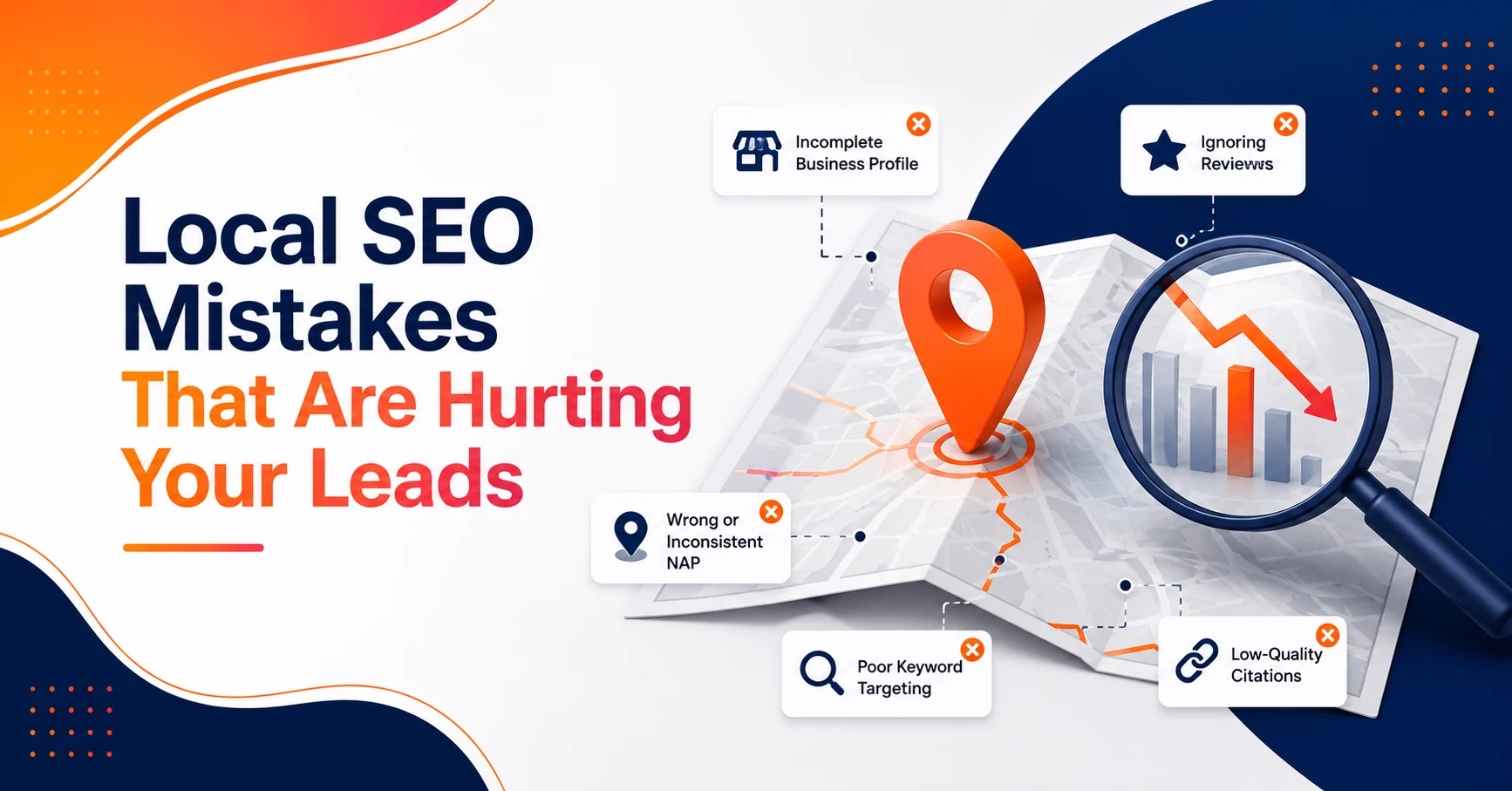
Most local SEO mistakes are not dramatic. They are small gaps in your Google Business Profile, citations, location pages, reviews, and tracking.
Losing calls from nearby customers? Request a free local SEO audit from Varun Digital Media.
Table of Contents
What are the biggest local SEO mistakes hurting leads?
The biggest local SEO mistakes are incomplete Google Business Profile setup, weak location pages, inconsistent citations, missing reviews, poor mobile experience, thin service content, and no lead tracking.
Google says local rankings are mainly influenced by relevance, distance, and prominence, and a complete, accurate Business Profile helps customers understand what a business does, where it is, and when they can visit.
That means local SEO is not just about adding a city name to a page. It is about giving Google and customers the right signals everywhere your business appears online.
Varun Digital Media’s local SEO services are built around local visibility, Google Business Profile optimization, local citations, reputation management, on-page SEO, and reporting for nearby searches.
Why does local SEO affect lead generation?
Local SEO affects lead generation because many customers search with immediate intent. They are not only browsing. They are comparing nearby options, checking maps, reading reviews, and deciding who to call.
A local searcher may type:
- “dentist near me”
- “real estate agent in Dallas”
- “best restaurant near downtown”
- “emergency plumber in Austin”
- “SEO company in New Jersey”
If your business does not appear in maps, organic results, or trusted local listings, the lead may never reach your website. Site Smart Marketing’s local SEO reference also highlights how customers search through “near me,” neighborhoods, service areas, mobile devices, maps, and voice search.
For a deeper foundation, connect this topic with Varun Digital Media’s guide on local SEO for small businesses.
Mistake 1: Incomplete Google Business Profile
An incomplete Google Business Profile can reduce your visibility in local search and Google Maps.
Many businesses create a profile and stop there. They miss service categories, business hours, photos, descriptions, service areas, appointment links, products, questions, and regular updates. Google’s own guidance says businesses with complete and accurate information are more likely to show in local search results.
Fix it by checking:
- Primary and secondary categories.
- Business name, address, and phone number.
- Business hours and holiday hours.
- Service areas and service list.
- Website, appointment, and contact links.
- Photos, videos, and recent posts.
- Review responses and FAQs.
Do not treat the profile like a one-time listing. Treat it like a local landing page that needs ongoing care.
Mistake 2: Weak Map Pack Signals
Weak map pack signals make it harder for your business to appear when nearby customers search for your service.
Map pack ranking is influenced by how relevant, close, and prominent your business appears. You cannot control where every searcher is located, but you can improve relevance and prominence through better categories, services, local content, reviews, links, and consistent business data.
Here is where many businesses fall behind:
| Local SEO Mistake | How It Hurts Leads | Practical Fix |
| Incomplete Google Business Profile | Reduces visibility in maps and local search | Complete every profile field and update it monthly |
| Inconsistent NAP details | Creates trust issues across directories | Match name, address, and phone everywhere |
| Weak location pages | Limits city-level visibility | Build unique pages for priority service areas |
| Few recent reviews | Reduces trust and local prominence | Ask customers for reviews after real service moments |
| No call/form tracking | Hides which pages generate leads | Track calls, forms, GBP clicks, and conversions |
Need to find what is blocking your map visibility? Explore Varun Digital Media’s local SEO services for a practical audit and fix plan.
Mistake 3: Inconsistent Business Citations
Citation inconsistency is one of the most common local SEO errors. It happens when your business name, address, phone number, website, hours, or categories differ across directories.
A customer may see one phone number on Google, another on Yelp, and outdated hours on a local directory. Google may also see mixed signals across the web.
Fix citation issues by auditing:
- Google Business Profile.
- Apple Business Connect.
- Bing Places.
- Yelp and industry directories.
- Chamber of commerce listings.
- Local business directories.
- Social profiles.
- Data aggregator listings.
Consistency does not guarantee rankings by itself, but inconsistency creates friction. Local SEO works better when every listing confirms the same business identity.
Mistake 4: Too Thin Location Pages
A weak location page usually says the same thing as every other page, with only the city name changed. That is not enough.
Strong location pages should explain the service, the local area served, customer pain points, proof, FAQs, contact options, and next steps. They should feel useful to someone in that city, not like a copied page.
A better location page includes:
- Service-specific local keyword usage.
- Unique city or neighborhood context.
- Clear service area details.
- Local testimonials or proof.
- FAQs based on local buyer questions.
- Internal links to related services.
- Strong contact and call buttons.
This connects directly with conversion-focused SEO. Varun Digital Media’s blog on SEO landing page tips can support the section on turning local traffic into calls and form submissions.
Mistake 5: Ignoring Reviews
Reviews affect more than reputation. They influence whether people trust your business enough to call.
BrightLocal’s local consumer review research tracks how consumers read and use reviews when choosing local businesses, and its 2026 survey focuses on how reviews drive actions such as checking websites, review platforms, social channels, and purchase decisions.
The mistake is not only having too few reviews. It is also ignoring review replies, letting old complaints sit unanswered, and failing to ask satisfied customers at the right time.
Fix review gaps by:
- Asking after a positive service experience.
- Making the review link easy to access.
- Responding to positive and negative reviews.
- Avoiding fake or incentivized reviews.
- Using review themes to improve service pages.
Reviews help people confirm what your website claims. That trust can be the difference between a visitor and a lead.
Mistake 6: Website Not Built for Mobile Local Search
Local buyers often search on mobile while they are ready to act. If your site loads slowly, hides phone numbers, breaks forms, or makes location information hard to find, the lead may leave.
Boldwerks also points out slow website performance, poor titles, thin content, missing schema, and technical issues as hidden SEO problems that can reduce local leads.
Fix mobile local SEO by checking:
- Click-to-call buttons.
- Fast page load speed.
- Visible address and service area.
- Short forms.
- Easy navigation.
- Sticky CTA buttons.
- Mobile-friendly maps.
- Clear service descriptions above the fold.
Local search does not end at ranking. The page must also convert the visitor.
Mistake 7: Not Tracking Calls, Forms, and Map Actions
Traffic without tracking is guesswork. A business may rank for some local keywords and still miss the bigger question: which searches actually create leads?
A proper local SEO audit should check:
- Google Business Profile calls.
- Website form submissions.
- Click-to-call actions.
- Direction requests.
- Search Console queries.
- Landing page conversions.
- Call source and quality.
- Top converting city pages.
Google’s SEO Starter Guide explains that SEO helps search engines understand content and helps users find a site and decide whether to visit through search. For lead-focused businesses, the next layer is tracking whether those visits turn into inquiries.
For related strategy support, connect this section with Varun Digital Media’s blog on local SEO optimization.
Mistake 8: Website with No Local Business Schema
Local Business structured data helps search engines understand details such as business hours, departments, and other business information. Google’s Local Business structured data documentation explains how this markup can provide details about a business in search experiences.
Schema does not replace a strong website or Google Business Profile. But it helps organize important details for search engines.
Useful schema types may include:
- LocalBusiness
- Organization
- Service
- FAQPage
- Review markup, where valid
- BreadcrumbList
- Article for blogs
The key is accuracy. Do not add fake reviews, incorrect hours, or markup that does not match visible page content.
How Can a Local SEO Audit Fix These Mistakes?
A local SEO audit finds the gaps between how your business appears online and how local customers actually search.
A useful audit should review:
- Google Business Profile completeness.
- Map pack competitors.
- Service and location keywords.
- Website structure.
- Location page quality.
- Citation consistency.
- Review profile and responses.
- Technical SEO issues.
- Schema markup.
- Lead tracking setup.
The goal is not to create a long report nobody uses. The goal is to identify the few fixes most likely to improve visibility, calls, and lead quality.
How Does Varun Digital Media Help Local Businesses Get More Leads?
Varun Digital Media helps local businesses improve search visibility across Google Maps, local organic results, service pages, and location-based searches.
The work usually starts with an audit. From there, the strategy can include Google Business Profile optimization, citation cleanup, local keyword targeting, location pages, review support, technical SEO, content updates, schema, and reporting.
This is important for service businesses, healthcare providers, real estate companies, restaurants, retail stores, local franchises, and multi-location brands that depend on nearby demand.
Get More Local Leads Without Guesswork
Find out what’s blocking your visibility in Google Maps and local search—and fix it fast.
FAQs
1. What are the most common local SEO mistakes?
The most common local SEO mistakes include incomplete Google Business Profile setup, inconsistent citations, weak location pages, poor reviews, no tracking, and missing local schema.
2. Why is my business not ranking in the Google map pack?
Your business may not rank in the map pack because of weak relevance, poor proximity signals, low prominence, incomplete profile data, few reviews, or stronger nearby competitors.
3. How often should I update my Google Business Profile?
A business should update its Google Business Profile whenever hours, services, photos, offers, or service areas change. Monthly checks help keep the profile accurate.
4. Do citations still matter for local SEO?
Yes. Citations still help confirm business identity across the web. They work best when name, address, phone, website, hours, and categories are consistent.
5. Do reviews help local SEO rankings?
Reviews support trust and local prominence. A strong review profile can improve customer confidence and help a business stand out in maps and local results.
6. What should a local SEO audit include?
A local SEO audit should include Google Business Profile review, citation check, competitor review, location page analysis, technical SEO, schema, reviews, and lead tracking.
Published: July 8th, 2026
Tags:
- business citations seo
- generate leads from seo
- google business profile optimization
- improve local rankings
- local lead generation
- local search optimization
- local seo audit
- local seo mistakes
- local seo services usa
- location pages seo
- map pack ranking
- mobile seo local search
- online reviews seo
- seo for small businesses