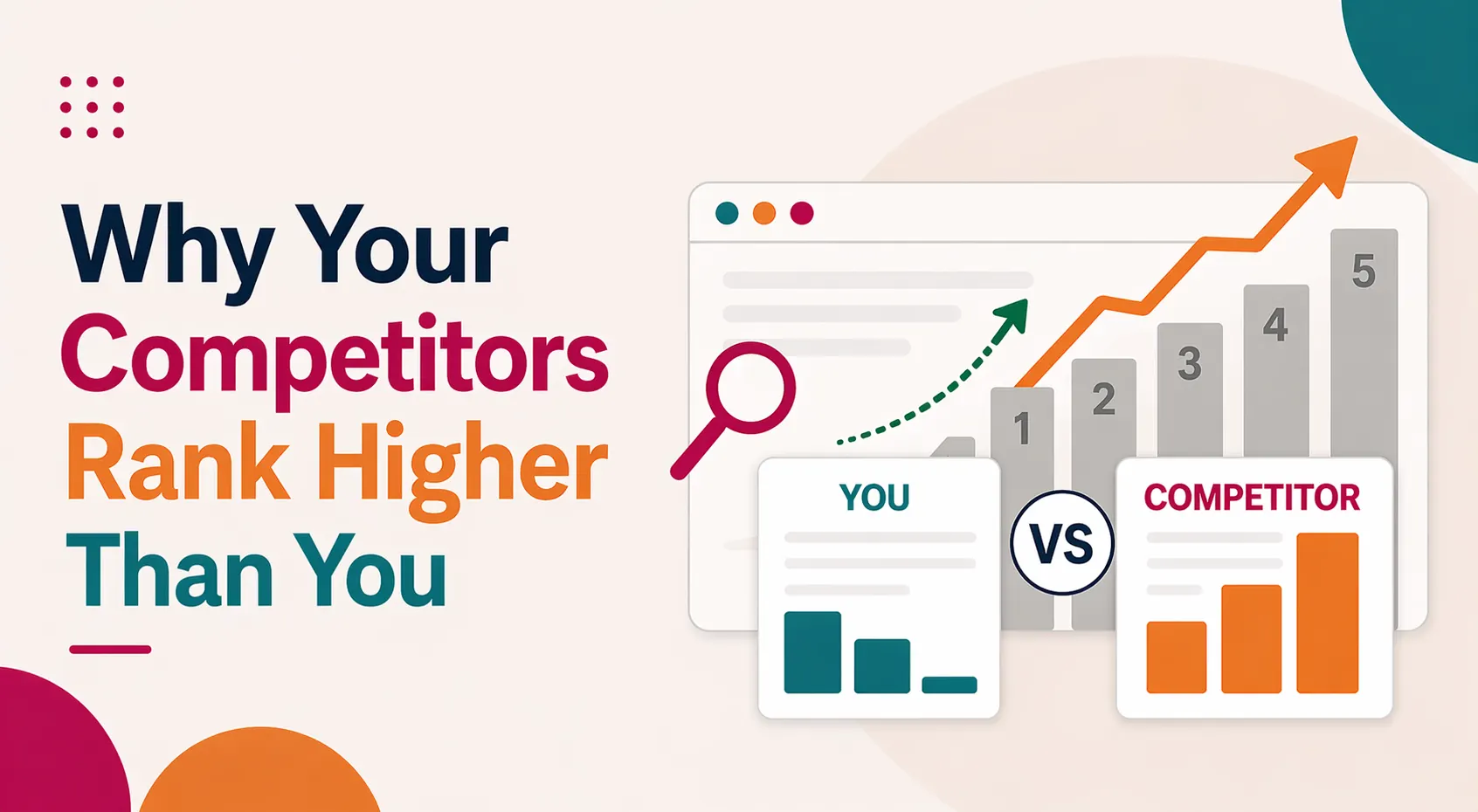
If you are trying to understand why your competitors rank higher than you, the gap usually sits beyond keywords and visible content, inside how your website is structured, interpreted, and prioritized by search engines. Many businesses invest time and effort, yet competitors are ranking higher than you because their execution connects structure, authority, and consistency into a system that search engines can evaluate clearly.
Ranking improves when actions follow the correct sequence, where technical clarity, content depth, and authority signals support each other instead of working in isolation. In most audits across mid-sized business websites, ranking gaps are rarely caused by a single issue, but by multiple small inefficiencies compounding over time.
The guide helps you break down what separates your website from those ranking above you and shows how to outrank your competitors through structured, high-impact improvements.
Table of Contents
Top Reasons Why Your Competitors Rank Higher Than You
Higher rankings are built through layered improvements. Competitors are ranking higher than you because they have refined key areas that directly influence visibility.
These are not random advantages. They are structured decisions applied consistently over time.
Why Your Competitors Rank Higher Than You: Better Site Architecture
Structure decides how search engines read your website.
Competitors often:
- Group pages under clear categories
- Maintain clean and readable URLs
- Use logical parent and child relationships
This creates a clear path for indexing, helping pages get discovered faster and ranked accurately.
What to fix
- Map your current URL structure
- Remove duplicate or unnecessary paths
- Organize pages into clear hierarchies
- Apply redirects where structure changes
Competitors Are Ranking Higher Than You Due to Stronger Topical Coverage
Competitors do not rely on isolated pages. They build connected topic layers and typically:
- Cover beginner to advanced queries
- Link related topics internally
- Expand content depth across clusters
This strengthens relevance across multiple search queries instead of relying on one keyword.
What to fix
- Identify missing topics your competitors cover
- Build structured content layers
- Connect pages through internal links
Why Your Competitors Rank Higher Than You: Schema and Search Visibility Enhancements
Some competitors stand out even before a click happens.
They use structured data to:
- Show FAQs directly in results
- Display ratings or additional information
- Improve click-through rates
This increases visibility even without changing rankings.
What to fix
- Add structured data based on page type
- Validate markup before publishing
- Focus on visibility-enhancing formats
Competitors Are Ranking Higher Than You Due to Backlink Quality
Not all links carry the same weight. Competitors often:
- Earn links from relevant industry sources
- Maintain natural anchor variations
- Focus on quality instead of volume
This builds stronger trust signals.
What to fix
- Analyze competitor backlink sources
- Focus on authority-based link acquisition
- Diversify anchor usage naturally
Why Your Competitors Rank Higher Than You: Content Refresh and Updates
Pages that rank do not stay unchanged. Competitors revisit their content to:
- Update data and insights
- Improve internal linking
- Expand sections based on new queries
This keeps their pages relevant and competitive.
What to fix
- Review top-performing pages regularly
- Expand sections where needed
- Align content with current search behavior
Competitors Are Ranking Higher Than You Due to Website Performance
Speed and stability influence both ranking and user behavior. Competitors often have:
- Faster load times
- Optimized media
- Reliable hosting environments
This reduces drop-offs and improves engagement.
What to fix
- Test site performance
- Optimize images and scripts
- Improve hosting response time
Why Your Competitors Rank Higher Than You vs Your Current Setup
| Performance Area | Your Website | Competitor Website |
| Structure | Scattered pages | Clear, logical hierarchy |
| Content Depth | Limited coverage | Layered, comprehensive topics |
| Backlinks | Low authority | Strong, high-quality references |
| Speed | Slower load times | Optimized for performance |
| Updates | Irregular | Consistent and strategic |
| Visibility | Unstable rankings | Sustained growth |
Even small differences across these areas create long-term ranking advantages.
The Real Pattern Behind Why Your Competitors Rank Higher Than You
It is not one factor. It is how multiple elements work together. Competitors are ranking higher than you because:
- Their structure supports indexing
- Their content supports relevance
- Their links support trust
- Their updates support consistency
This alignment builds momentum over time.
How to Outrank Your Competitors with Structured Improvements
Closing the gap requires focused execution.
Start with:
- Technical audit of structure & performance
- Content expansion based on gaps
- Link quality improvement
- Regular updates to existing pages
Each improvement builds on the previous one. Progress becomes visible when these actions are applied consistently.
Execution Gaps That Matter in Ranking better
Most businesses are aware of SEO fundamentals. The gap appears in execution. Competitors are ranking higher than you because they avoid fragmentation. They operate with:
- Defined workflows
- Consistent updates
- Prioritized improvements
This creates stability in rankings while others fluctuate.
Lack of Prioritization
Not every issue carries equal weight. Many websites:
- Fix low-impact problems first
- Delay critical structural improvements
- Spread efforts across too many areas
Competitors focus on high-impact changes first. That creates faster ranking improvements.
Due to Consistency
Consistency builds authority over time. Competitors often:
- Publish and update regularly
- Maintain internal linking structure
- Track performance changes
This creates steady growth rather than short-term spikes.
Disconnected Strategy
When content, technical elements, and performance tracking operate separately, results remain limited.
Competitors align:
- Content visibility
- Technical structure
- User interaction flow
This alignment improves both rankings and engagement
Comparison Overview:
SEO Area
Low Execution Impact
High Execution Impact
Website Structure
Disorganized pages, weak crawlability
Clear hierarchy, strong indexing
Content Depth
Surface-level information
Complete topic coverage
Internal Linking
Isolated pages
Connected content ecosystem
Backlinks
Low authority sources
Relevant, high-trust links
Content Updates
Static pages
Regular refinement
Technical Health
Unresolved issues
Stable performance foundation
Strategy Alignment
Fragmented efforts
Unified execution flow
How to Outrank Your Competitors with a Clear Action Plan
To understand how to outrank your competitors, focus on execution clarity rather than adding more tasks. A structured plan includes:
Step 1: Identify Why Your Competitors Rank Higher Than You
Start with a direct comparison.
Evaluate:
- Content coverage gaps
- Backlink strength
- Page structure
- Technical performance
This reveals where competitors are gaining an advantage.
Step 2: Fix High-Impact Technical Barriers
Before scaling content, ensure:
- Pages load efficiently
- Crawling issues are resolved
- Structure supports indexing
Without this, improvements remain limited.
Step 3: Expand Content Based on Search Depth
Competitors are ranking higher than you because they answer more queries.
Focus on:
- Expanding existing pages
- Adding missing sections
- Covering related topics
This builds stronger topical relevance.
Step 4: Strengthen Authority Signals
Authority grows through external validation.
Work on:
- High-quality backlinks
- Relevant mentions
- Consistent brand signals
This improves trust and ranking stability.
Step 5: Maintain Continuous Optimization
Ranking is not static.
Sustain growth by:
- Updating pages regularly
- Monitoring performance
- Refining based on data
This keeps your website competitive over time.
Why Your Competitors Rank Higher Than You and What Changes Next
Ranking differences are not permanent. They reflect:
- Gaps in execution
- Missed opportunities
- Lack of structured improvements
Once these areas are addressed, visibility starts shifting. What matters is not identifying problems alone, but applying changes in the right sequence.
Conclusion
If your competitors are ranking higher than you, the difference is rarely accidental. It comes from structured execution, consistent updates, and alignment between content, technical foundation, and authority signals.
Most websites do not fail due to a lack of effort. They fail due to scattered improvements that do not connect.
Once execution becomes structured, results begin to stabilize. Visibility improves, traffic becomes more relevant, and growth becomes measurable. The shift does not come from doing more. It comes from doing the right things in the right order. The difference becomes visible when execution shifts from scattered efforts to structured action.
How Varun Digital Media Helps You Outrank Your Competitors
Outranking competitors is not handled through isolated fixes. It requires structured execution where every improvement connects to visibility, engagement, and conversion.
Varun Digital Media focuses on building that connection from the ground up. The approach is built on clarity, prioritization, and continuous refinement rather than scattered actions.
Key Advantages of Working with Varun Digital Media
- Structured analysis of why your competitors rank higher than you
- Clear mapping between technical issues and business impact
- Focused execution aligned with visibility and conversions
- Continuous performance tracking to prevent ranking drops
- Scalable frameworks that grow with your business
Each step is designed to move beyond observation and into measurable progress.
Outrank Your Competitors
Get clarity on why your competitors rank higher than you and move toward structured improvements that drive measurable growth.
Frequently Asked Questions
1. Why do your competitors rank higher than you, even with similar content?
Even when content appears similar, competitors often structure it better for search engines and users. Their pages are easier to crawl, better organized with clear heading hierarchy, and internally linked across related topics. They also tend to update content more frequently, which keeps it aligned with search intent.
Small differences in structure, freshness, and internal linking can create a large gap in rankings, even when the visible content looks similar.
2. How to outrank your competitors without increasing budget?
Outranking competitors without increasing budget depends on improving efficiency rather than expanding effort. Focus on fixing technical issues that limit visibility, updating existing pages instead of creating new ones, and strengthening internal linking.
Most websites already have untapped potential. Improving what exists often delivers faster results than adding new content or increasing spending.
3. Are competitors ranking higher than you due to backlinks or content?
Competitors gain an advantage when both backlinks and content work together. Backlinks increase trust and authority, while content ensures relevance for search queries.
If content is strong but authority is weak, rankings remain limited. If backlinks are strong but content lacks depth, performance also plateaus. Competitors who align both areas consistently gain higher positions.
4. How long does it take to outrank competitors?
The timeline depends on how large the gap is between your website and your competitors. Technical fixes and content updates may show early improvements within a few weeks, while authority building takes longer.
Sustainable ranking improvements typically develop over a few months, especially in competitive industries where multiple factors influence positioning.
5. Can small businesses outrank established competitors?
Smaller businesses can outperform larger competitors by focusing on specific gaps rather than competing broadly. Targeting niche topics, improving page structure, and maintaining consistent updates allow smaller websites to build relevance faster.
Search engines prioritize clarity and usefulness, not size alone. Focused execution often outperforms scale.
Published: April 20th, 2026