Ultimately, no matter how search evolves, content is for humans to read and understand. But that information is fetched by the large language models. Hence, content structure for AI search should be organized so that both human readers and large language models can understand, extract, summarize, and trust the information. It is not about writing robotic content for machines. It is about making useful content easier to read, verify, and quote.
The rise of AI has changed the way people search for information on the internet. Though people still use Google, they are expecting direct answers from AI Overviews, ChatGPT, Gemini, Perplexity, and Copilot. These systems often break content into smaller sections or excerpts, identify the clearest answer, compare it with other sources, and then generate a response.
That means your content has to work in two directions. It should feel natural for real readers, but it should also be structured clearly enough for AI systems to understand the main answer, supporting details, entities, examples, and context.
A good AI content writing structure helps humans read faster and helps LLMs retrieve better.
Table of Contents
Quick Answer: What Makes Content AI-Readable?
AI-readable content structure uses clear headings, answer-first paragraphs, short sections, semantic terms, structured lists, comparison tables, FAQs, schema, and consistent language. The goal is to help AI systems understand what each section means without making the article feel stiff or over-optimized.
For readers, this improves flow. For search engines, it improves page clarity. For LLMs, it creates clean passages that can be retrieved, summarized, and cited. For brands, it improves the chance of being understood correctly across traditional search and AI answer engines.
The best approach is simple: write for people first, then structure the page so machines can read it without confusion.
Why Content Structure Matters More in AI Search
Traditional SEO often focused on ranking a full page for a keyword. AI search is more passage-driven. An answer engine may use one definition, one FAQ, one table, one comparison point, or one short paragraph from your page.
That makes structure more important than ever.
If the best answer is buried inside a long paragraph, AI may miss it. If headings are vague, the section may not match the user’s question. If key terms are inconsistent, the model may misunderstand your topic, product, service, or claim.
This is where content structure SEO becomes important. A page should not only include the right information. It should present that information in a format that is easy to scan, parse, and reuse.
Good structure supports:
- Better organic visibility
- Stronger featured snippet optimization
- Clearer AI Overview eligibility
- Better LLM citations
- Improved user engagement
- Stronger topical authority
- Cleaner entity signals
- Faster answer discovery
AI search has made one thing clear: clarity is now a ranking, citation, and trust signal.
Write for Humans First, Then Support LLMs
A common mistake is thinking AI search requires machine-first writing. That usually leads to dry paragraphs, repeated keywords, and unnatural headings.
The better approach is to write for the person who needs the answer, then organize the content so an AI system can understand it too.
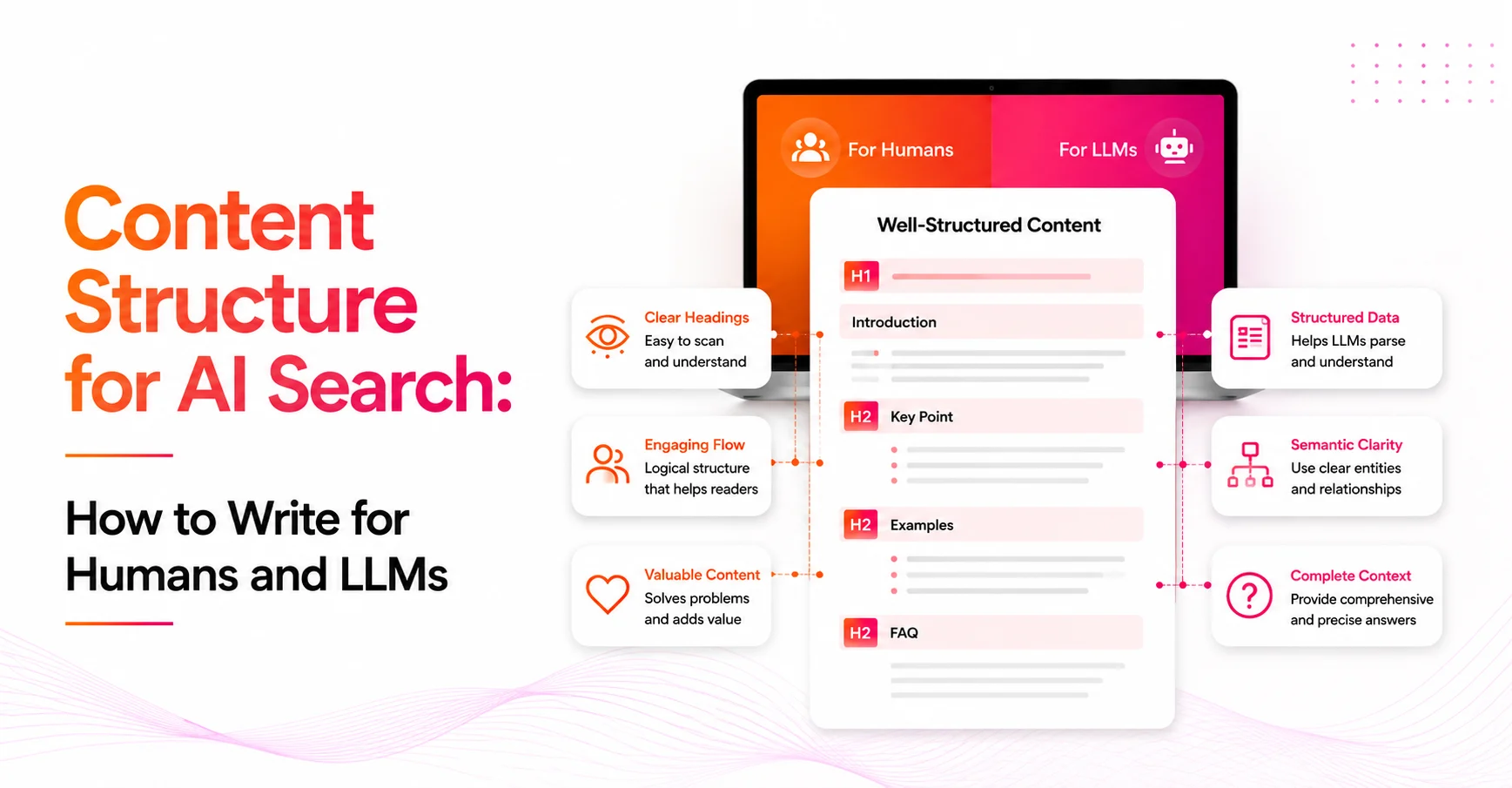
A human reader wants a clear answer, useful examples, simple explanations, proof, and a natural flow. An LLM needs clear section meaning, self-contained paragraphs, structured facts, related entities, and consistent terminology.
These need to work together. A direct answer under a clear H2 helps a busy reader and an AI system. A comparison table helps a buyer make a decision and helps an answer engine extract differences. An FAQ section helps users get fast answers and helps AI retrieve question-based responses.
Structured content SEO is not separate from good writing. It is good writing made easier to navigate.
The Best SEO Writing Format for AI Search
The best SEO writing format for AI search is answer-first, structured, and easy to scan. Each major section should open with the main point before moving into details, examples, or explanations.
A strong format usually includes:
- A clear H1 with the core topic
- A short introduction with the direct answer
- H2s based on real user questions or decision points
- H3s for examples, steps, and supporting ideas
- Short paragraphs with one idea each
- Lists for steps, features, mistakes, and checks
- Tables for comparisons and decisions
- FAQs for conversational search queries
- Schema suggestions where useful
- A conclusion that restates the value clearly
For example, instead of using a vague heading like “Important Writing Tips,” use a question-based heading such as “How Should You Structure Content for AI Search?”
Then answer it directly:
To structure content for AI search, use clear headings, answer-first paragraphs, semantic SEO, structured lists, tables, FAQs, and schema markup so both humans and LLMs can understand the page quickly.
That one paragraph can work for readers, featured snippets, and AI-generated answers.
How to Build Content Structure for AI Search
Content structure for AI search should be planned before writing. Do not write a long article first and then try to force structure later. The outline should guide the reading path and the retrieval path.
Start by identifying the reader’s real question. Are they trying to learn, compare, solve, audit, or decide? Then build headings around that intent.
For example:
- What is the content structure for AI search?
- How do you make content readable for LLMs?
- What is the best SEO writing format for AI search?
- How does semantic SEO help AI visibility?
- What content formatting SEO practices improve readability?
- How do FAQs help AI answer engines?
This is question-based content SEO. It works because modern users often search in full questions, especially inside AI tools.
Once the questions are clear, write answer-focused content under each heading. Answer first, then add explanation, examples, and practical steps.
Use Semantic SEO Without Keyword Stuffing
Semantic SEO helps search engines and LLMs understand the relationship between topics, entities, and user intent. It is not about repeating one keyword. It is about covering the topic with the right supporting ideas.
For a page about content structure for AI search, related entities may include:
- AI search
- LLMs
- AI Overviews
- featured snippets
- answer engines
- structured data
- schema markup
- search intent
- content chunks
- entity optimization
- knowledge graph
- FAQs
- semantic relevance
- passage retrieval
- topical authority
These terms help define the page’s subject area. But they should appear naturally. Do not add them to the checklist if they do not help the reader.
A strong semantic SEO section should define the main concept, explain related concepts, and show how they affect real content decisions.
For example, “structured content SEO” should be explained as the practice of organizing content with clear hierarchy, headings, answer blocks, lists, tables, FAQs, and schema so both search engines and users can understand the page more easily.
That gives the keyword meaning instead of just placement.
Make Every Section Self-Contained
LLMs often retrieve specific content chunks, not always the full page. That means each important section should make sense on its own.
Weak phrasing:
“This approach improves visibility.”
Better phrasing:
“Answer-focused content improves AI search visibility because it gives LLMs a clear response that can be extracted, summarized, and cited.”
The second version has context. It does not force the reader or AI model to look backward to understand the sentence.
Self-contained sections also help human readers. Many users skip, jump between headings, or land in the middle of a page from search. If each section is complete, the article becomes easier to use.
Content Formatting SEO: What Actually Helps?
Content formatting SEO is not decoration. It is the practice of making information easier to read, scan, compare, and extract.
Use formatting when it improves clarity:
- Use H2s for major questions or decision points.
- Use H3s for examples, steps, and subtopics.
- Use bullets for benefits, checks, and mistakes.
- Use numbered lists for processes.
- Use tables for comparisons.
- Use short paragraphs for mobile readability.
- Use descriptive internal links.
- Use image alt text that explains the visual clearly.
- Use bold text only for important phrases.
Avoid formatting that hides meaning:
- Long unbroken paragraphs
- Clever headings that do not explain the section
- Image-only text
- Overloaded tabs
- Thin FAQs
- Repeated keyword blocks
- Vague links like “click here”
Good formatting should make the page feel calmer, not busier.
AI-Readable Structure vs Traditional Blog Structure
| Content Element | Traditional Blog Style | AI Search-Friendly Style |
| Introduction | Builds slowly | Gives the direct answer early |
| Headings | Broad or creative | Clear and descriptive |
| Paragraphs | Long explanations | Short, complete ideas |
| Keywords | Exact-match repetition | Semantic coverage |
| Formatting | Mostly prose | Lists, tables, FAQs |
| Examples | Optional | Used to clarify meaning |
| FAQs | Added at the end | Built from real questions |
| Schema | Often skipped | Used where it supports clarity |
This does not mean every article should look the same. It means the page should match the reader’s journey and make the information easier to retrieve.
How to Optimize for Featured Snippets and AI Answers
Featured snippet optimization still matters because AI systems often prefer concise, direct, well-structured answers. A paragraph that works for a snippet can also work as an AI answer source.
To improve snippet and AI answer readiness:
- Put the answer immediately under the heading.
- Keep the first answer clear and concise.
- Use the main entity in the first sentence.
- Use a list when the answer involves steps.
- Use a table when the answer involves comparison.
- Avoid long introductions before the answer.
- Use plain language.
- Add context around claims.
Example:
What Is AI Readable Content Structure?
AI readable content structure is a way of organizing content so AI systems can identify the topic, question, answer, supporting details, and source context. It uses clear headings, short paragraphs, structured lists, tables, FAQs, schema, and consistent terminology.
That answer is short, complete, and easy to extract.
Common Mistakes Brands Make
Many brands understand the need for AI-friendly structure but apply it mechanically. They add FAQs, tables, and keywords without improving the usefulness of the content.
Common mistakes include:
- Writing long intros that delay the answer
- Using vague headings like “Overview” or “Benefits”
- Repeating the primary keyword too often
- Adding generic FAQs with thin answers
- Using tables where a paragraph would be clearer
- Publishing AI-written content with no original insight
- Ignoring internal links and entity relationships
- Hiding important text inside design elements
- Forgetting to update older pages
- Writing for tools instead of real people
A page does not become AI-friendly because it has a table and FAQ. It becomes AI-friendly when every section is clear, useful, and connected to the main topic.
Practical AI Content Writing Structure
| Step | What to Do | Why It Helps |
| Define intent | Identify what the reader wants to know or decide | Keeps the article focused |
| Write the direct answer | Place the main answer in the first 100–150 words | Helps readers and AI understand the page quickly |
| Build question headings | Use H2s and H3s based on real queries | Supports question-based content SEO |
| Add semantic terms | Include related entities and concepts naturally | Strengthens topical clarity |
| Use structured blocks | Add lists, tables, and examples where useful | Improves readability and extraction |
| Add FAQs | Answer long-tail and conversational questions | Improves AEO and FAQ schema value |
| Review the flow | Read aloud and remove robotic phrasing | Keeps the content human |
The goal is not to create a rigid template. The goal is to make every article easier to understand, cite & act on.
How to Audit Existing Content for AI Search
Many brands already have useful content, but the structure may be weak. Start by reviewing high-value pages section by section.
Look for:
- Long introductions
- Missing direct answers
- Vague H2s
- Dense paragraphs
- Weak internal links
- No FAQs
- Missing schema
- Repeated keywords
- Outdated examples
- Claims without support
Then improve the page in stages. Rewrite the introduction so the answer appears early. Replace broad headings with clearer questions. Break dense paragraphs into shorter sections. Add examples, lists, or tables only where they improve understanding. Update FAQs so they answer real user questions.
For example, a heading like “Benefits” can become “Why Does Structured Content Help AI Search Visibility?” That small change improves clarity for both readers and AI systems.
How to Measure Whether the Structure Works
After publishing, measure whether the new structure improves visibility and engagement.
Track:
- Google rankings for primary and secondary keywords
- Featured snippet visibility
- AI Overview presence
- Brand mentions in ChatGPT, Gemini, Perplexity, and Copilot
- Pages cited by AI answer engines
- Search Console query growth
- Organic clicks and impressions
- Engagement time
- Scroll depth
- Internal link clicks
- Conversions from informational pages
- AI referral traffic where available
Do not measure success only by traffic. AI search may answer some queries directly, reducing clicks for certain searches. The better question is whether your brand is being understood, cited, trusted, and chosen.
Conclusion
Content structure for AI search is not about abandoning human writing. It is about making strong writing easier to understand, extract, and trust.
The strongest pages use structured content SEO, semantic SEO, answer-focused content, and clean content formatting SEO. They answer questions clearly, organize sections logically, use tables where useful, include FAQs, and support the page with schema.
For humans, this creates a better reading experience. For LLMs, it creates a clearer source. For brands, it improves the chance of being found, cited, and remembered across Google, AI Overviews, ChatGPT, Gemini, Perplexity, Copilot, and future answer engines.
Write for people first. Structure for machines second. That is the balance modern SEO now requires.
Ready to Make Your Content Visible in AI Search?
Optimize your content for Google AI Overviews, ChatGPT, Gemini, and other answer engines with SEO strategies built for the future of search.
FAQs
1. What is content structure for AI search?
Content structure for AI search is the way content is organized so humans and AI systems can understand the topic, extract answers, and trust the source. It uses clear headings, answer-first writing, semantic SEO, lists, tables, FAQs, and schema.
2. What is structured content SEO?
Structured content SEO is the practice of organizing content with a clear hierarchy, meaningful headings, answer blocks, internal links, FAQs, schema, and clean formatting so search engines and readers can understand the page easily.
3. What is the best SEO writing format for AI search?
The best SEO writing format starts with a direct answer, then uses question-based headings, short paragraphs, semantic terms, examples, lists, tables, FAQs, and schema. This format supports both traditional SEO and AI answer retrieval.
4. How does semantic SEO help LLMs?
Semantic SEO helps LLMs understand context by connecting related topics, entities, synonyms, attributes, and examples. It shows what the page is about beyond one exact keyword.
5. Does AI readable content structure make writing robotic?
No. AI readable content structure should make content clearer, not robotic. The best pages still sound human, practical, and thoughtful. They simply organize answers in a way that is easier to find and cite.
6. How do FAQs help AI search?
FAQs help AI search because they match conversational user queries. A clear question and direct answer can be retrieved easily by answer engines and can also support FAQPage schema.
7. Which schema types help AI search content?
Useful schema types include Article schema, FAQPage schema, HowTo schema for step-based content, Organization schema for brand clarity, and BreadcrumbList schema for site structure.
Published: June 23rd, 2026