Every wasted click in Google Ads has a cost. The bigger problem is that most businesses do not see the waste until the monthly ad spend is already gone.
A campaign may look active, get clicks, and even generate leads, but if those leads are weak, delayed, irrelevant, or too expensive to close, the account is not really performing. It is only spending.
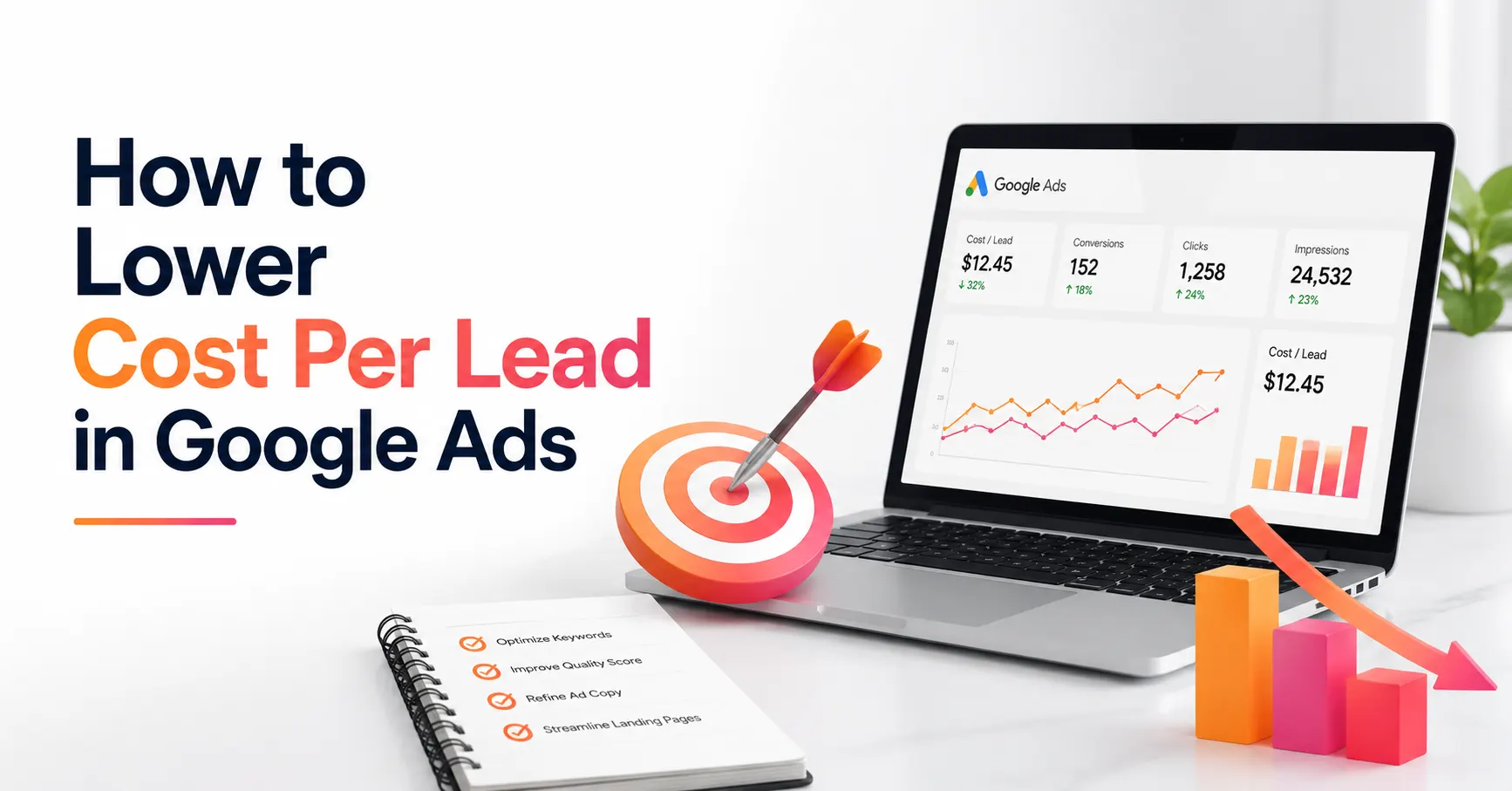
To lower the cost per lead in Google Ads, the first step is not cutting the budget. It is finding which part of the campaign is leaking money, from search terms and targeting to landing pages, tracking, and lead quality.
Need your campaigns reviewed before the next budget cycle? Get a PPC audit from Varun Digital Media and find what is increasing your lead cost.
Table of Contents
What is the cost per lead in Google Ads?
Cost per lead is the amount spent to generate one lead from a campaign.
The formula is simple:
Cost per lead = Total ad spend ÷ Total leads
If a business spends $2,000 and gets 40 leads, the CPL is $50.
But the number alone does not tell the full story. A $25 lead can be expensive if most leads are junk. A $90 lead can be profitable if those leads turn into booked consultations, estimates, demos, or high-ticket sales.
That is why reducing CPL should not mean chasing the cheapest form submission. The better goal is to reduce wasted spend while increasing qualified leads.
Why is your Google Ads cost per lead so high?
A high Google Ads CPL usually comes from one of four problems: poor targeting, weak ad relevance, low landing page conversion, or bad tracking.
Google’s Quality Score is influenced by expected click-through rate, ad relevance, and landing page experience, which means the ad, keyword, and landing page must work together.
Before touching the budget, check where the leak is.
| CPL Problem | What It Usually Means | What to Fix First |
| High clicks, low leads | Traffic is not converting into actions | Improve landing page, offer, form, and CTA clarity |
| Low CTR, high CPC | Ads are not matching user intent | Optimize ad copy, keyword grouping, and relevance |
| Many poor-quality leads | Campaign is targeting the wrong audience | Refine search terms, add negative keywords, improve lead qualification |
| Good leads, high CPL | High competition or funnel friction | Adjust bidding, improve scheduling, build landing page trust |
| Low CPL but poor sales feedback | Tracking includes weak or unqualified conversions | Fix conversion tracking and implement lead scoring |
Most advertisers rush into bid changes. That may reduce spend for a few days, but it rarely fixes the real issue.
How do you lower cost per lead without losing lead quality?
Lower CPL by removing waste first, not by simply lowering bids.
Start with the search terms report. Look at the actual phrases people typed before clicking. If irrelevant searches are spending money, add negative keywords. Google explains that negative keywords help exclude search terms so ads can focus on keywords that matter to customers.
Then check the landing page. Does it match the ad promise? Is the CTA clear? Is the form easy? Is there enough trust for someone to submit their details?
A practical order works best:
- Fix conversion tracking before making major decisions.
- Remove irrelevant search terms with negative keywords.
- Split broad ad groups into tighter keyword themes.
- Improve ad relevance for each search intent.
- Send traffic to a page built for that offer.
- Review lead quality with sales, not only form volume.
- Adjust bids after the campaign data is clean.
This is the difference between reducing CPL and damaging performance.
Is your conversion tracking giving you the wrong CPL?
Many Google Ads accounts look expensive because tracking is messy.
Others look successful because they count every small action as a lead.
That creates bad optimization. If the campaign is counting page visits, button clicks, duplicate forms, spam leads, or unqualified inquiries as conversions, Google Ads may start optimizing toward the wrong actions.
For lead generation, track actions that show real intent:
- Form submissions
- Phone calls from ads
- Calls from landing pages
- Appointment requests
- Quote requests
- Demo requests
- Qualified CRM stages, where possible
Do not treat every click as equal. A “contact page visit” is useful behavior, but it is not the same as a booked consultation.
For a deeper PPC setup review, connect this topic with Varun Digital Media’s PPC optimization guide.
How does ad relevance reduce cost per lead?
Ad relevance matters because people click faster when the ad matches what they searched for.
A user searching “emergency plumbing repair near me” should not see a generic “Best Plumbing Company” ad. The keyword, headline, description, landing page, and CTA should all stay close to the same intent.
Better ad relevance can improve click-through rate and support stronger Quality Score signals. Google lists ad relevance as one of the three main Quality Score components.
Use tighter ad groups instead of dumping too many keywords into one campaign.
For example:
Weak structure:
One ad group for “law firm marketing,” “SEO for attorneys,” “PPC for lawyers,” and “legal website design.”
Better structure:
Separate ad groups for PPC, SEO, website design, and lead generation.
That gives each ad a cleaner message. It also makes landing page alignment easier.
Can landing pages lower Google Ads CPL?
Yes. A stronger landing page can lower cost per lead because the same traffic converts at a higher rate.
Many campaigns lose money after the click. The ad does its job, but the page does not.
A good landing page should answer three questions quickly:
- Is this exactly what I searched for?
- Can this business solve my problem?
- What should I do next?
That means the headline should match the ad. The page should explain the offer in plain language. The CTA should be visible without forcing the visitor to hunt for it.
Add trust, but do not overload the page. Reviews, case snippets, service proof, location relevance, certifications, and simple process sections can all help.
For more landing page improvement ideas, use Varun Digital Media’s guide on SEO landing page tips.
What bidding strategy works best for reducing CPL?
The right bidding strategy depends on the amount and quality of conversion data.
If tracking is weak, automated bidding may optimize toward the wrong signals. If tracking is clean and the account has enough conversion history, automated bidding can support better Google Ads efficiency.
Do not change bidding just because CPL is high. First ask:
- Are conversions tracked correctly?
- Are spam and low-quality leads filtered?
- Are campaigns grouped by intent?
- Is the landing page converting well?
- Is the campaign getting enough conversion volume?
- Are budget limits restricting learning?
For many businesses, the smarter move is to clean the account before switching bidding strategies. A broken funnel with automated bidding is still a broken funnel.
How do negative keywords reduce wasted spend?
Negative keywords protect budget from searches that do not fit the offer.
A business selling premium legal services may not want clicks for “free legal advice.” A B2B software company may not want “jobs,” “training,” “template,” or “PDF” searches. A contractor may want to exclude DIY searches.
Google allows advertisers to use negative keywords to prevent ads from showing for specific terms.
Build negative keyword lists from real search data, not guesses alone.
Good places to check:
- Search terms report
- Sales notes
- CRM lead quality data
- Common irrelevant inquiries
- Competitor and job-related searches
- Low-intent research terms
This is one of the fastest ways to reduce wasted lead cost.
Should you use ad scheduling to lower CPL?
Ad scheduling can help when leads are cheaper or better during certain hours.
Some businesses get strong leads during business hours because the sales team can answer quickly. Others see cheaper form leads at night, but the close rate may be poor.
Google Ads ad schedules allow ads to show or adjust bids at selected times.
Do not schedule based only on CPL. Check lead quality by time of day.
A campaign may get low-cost leads at 11 PM, but if those leads rarely answer the phone the next morning, the true cost is higher than it looks.
Look at:
- Hour of day
- Day of week
- Call answer rate
- Form-to-appointment rate
- Sales-qualified lead rate
- Closed revenue, if available
Good scheduling is not about being offline more often. It is about spending harder when the business can respond and convert.
What is the 10-point checklist to lower cost per lead?
Use this checklist before increasing or reducing budget.
- Confirm that only real lead actions are counted as conversions.
- Review search terms and add negative keywords weekly.
- Separate high-intent and research keywords into different campaigns.
- Match ad copy closely to the keyword and landing page.
- Improve landing page headline, CTA, trust signals, and form clarity.
- Pause keywords spending money without qualified leads.
- Use device data to find where poor leads are coming from.
- Review ad scheduling by lead quality, not just lead volume.
- Send offline lead quality feedback back into campaign decisions.
- Compare CPL with sales-qualified lead cost and customer acquisition cost.
This checklist keeps the focus on profit, not just cheaper clicks.
Mid-blog CTA: Spending on clicks that are not turning into qualified leads? Talk to Varun Digital Media and get a cleaner PPC action plan.
How can sales feedback improve Google Ads performance?
Sales feedback is one of the most ignored parts of Google Ads optimization.
The ad platform can show clicks, impressions, conversions, CPC, and CPL. It cannot always tell which leads wasted the sales team’s time unless that data is passed back.
Ask sales to tag leads as:
- Qualified
- Wrong service
- Wrong location
- No budget
- Spam
- Duplicate
- Competitor
- Job seeker
- Not ready
This feedback changes how campaigns are judged.
A keyword with a $40 CPL may look good until sales says most leads are unqualified. Another keyword with a $110 CPL may be worth scaling if those leads book faster and close at a higher rate.
That is how businesses move from lead generation to revenue-focused PPC.
How Varun Digital Media helps reduce CPL
Varun Digital Media builds PPC campaigns around lead quality, cost control, and conversion tracking.
The work starts with account diagnosis: campaign structure, search terms, conversion setup, landing page relevance, keyword intent, audience exclusions, and lead quality. From there, the strategy becomes more focused.
For small businesses, this matters because every wasted click affects cash flow.
Varun Digital Media’s PPC management services focus on more leads, lower costs, and higher returns through data-driven campaign management.
The team can support:
- Google Ads campaign audits
- PPC optimization
- Conversion tracking cleanup
- Search term and negative keyword review
- Landing page recommendations
- Ad copy and quality score improvements
- Budget allocation and bidding strategy
- Lead quality reporting
For budget planning, also read Varun Digital Media’s guide on Google Ads cost.
Final thoughts
Lowering cost per lead is not about making Google Ads cheaper at any cost.
It is about finding where money is leaking, improving the path from click to lead, and making sure the leads are worth the spend.
Start with tracking. Then clean the traffic. Improve ad relevance. Fix the landing page. Review sales feedback. Only then make bigger bidding or budget decisions.
That is how reducing CPL becomes a growth move instead of a budget cut.
Fix Your Google Ads Before You Spend More
We’ll show you exactly where your budget is leaking and how to reduce CPL fast.
FAQs
1. What is a good cost per lead in Google Ads?
A good cost per lead depends on the industry, sales value, location, and close rate. The best benchmark is not the cheapest CPL, but the CPL that produces profitable qualified leads.
2. Why is my Google Ads CPL increasing?
Your CPL may increase because of higher competition, broad keywords, weak ad relevance, poor landing page conversion, bad tracking, or low-quality traffic using up budget.
3. How can I lower cost per lead quickly?
Start by reviewing search terms, adding negative keywords, checking conversion tracking, pausing wasteful keywords, and improving the landing page CTA.
4. Does Quality Score affect cost per lead?
Yes. Quality Score is connected to expected click-through rate, ad relevance, and landing page experience. Stronger alignment can support better campaign efficiency.
5. Should I lower bids to reduce CPL?
Not immediately. Lowering bids may reduce traffic without fixing the issue. Diagnose tracking, keywords, landing pages, and lead quality before changing bids.
Published: July 10th, 2026