Most marketers are using LLMs to write faster. The better ones are using them to think more sharply.
That is the real shift.
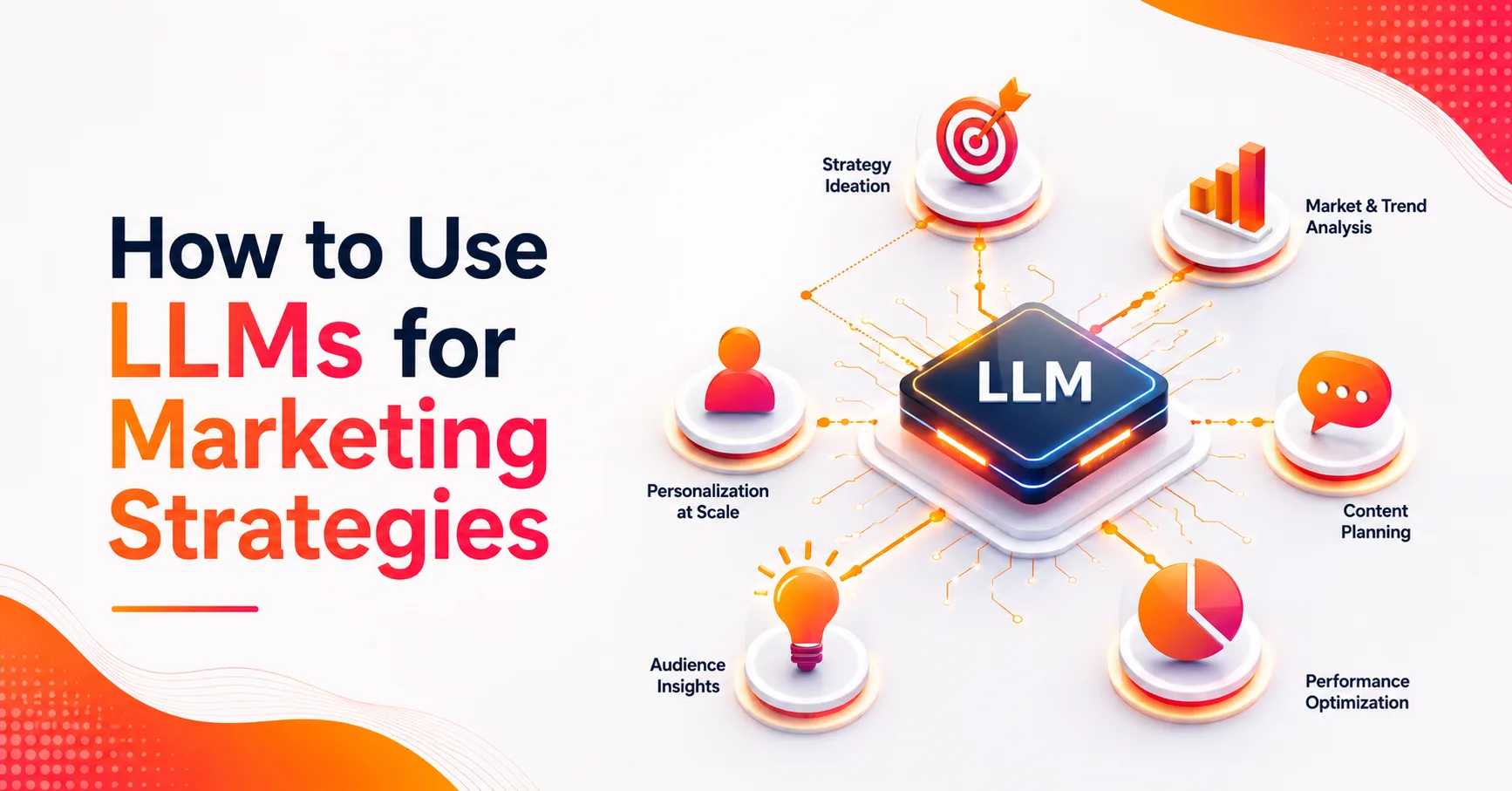
Large language models are no longer just tools for writing captions, blog intros, or email subject lines. They are becoming thinking partners for audience research, competitor analysis, content strategy, ad testing, customer support, personalization, and campaign planning.
The question is not, “Can ChatGPT write marketing content?”
The better question is, “How can marketers use LLMs to make better decisions before money is spent?”
That is where the opportunity is.
Table of Contents
What Are LLMs in Marketing?
LLMs, or large language models, are AI systems trained to understand and generate language. In marketing, they help teams work with words, intent, patterns, questions, objections, reviews, search behavior, and customer conversations.
In simple terms, large language models marketing is about using AI to understand what people want, how they speak, what stops them from buying, and what message may move them closer to action.
A normal marketer may look at ten customer reviews and spot a few common complaints.
An LLM can scan hundreds of reviews, sales call notes, survey answers, ad comments, chatbot logs, and competitor pages to find repeated patterns. It can show what customers care about, what language they use, what questions keep coming back, and what promises sound believable.
That does not replace strategy. It improves the raw material behind the strategy.
Why LLMs Matter for Marketing Strategy Now
Marketing has become harder because customers are harder to read.
They compare more. They trust less. They ask specific questions. They move between Google, social media, YouTube, Reddit, AI search, review sites, and brand websites before they decide.
This is where AI marketing strategies using LLMs become useful.
LLMs help marketers connect scattered signals. Search queries, customer objections, sales conversations, FAQs, website behavior, competitor messaging, and campaign data can be turned into clearer insights.
McKinsey estimates that generative AI could increase marketing productivity by 5 to 15 percent of total marketing spending, especially through content creation, better use of data, personalization, SEO, and product discovery. HubSpot’s 2026 State of Marketing report also notes that AI has become a baseline workflow for marketers, with 80 percent using AI for content creation and 75 percent using it for media production.
But productivity is only part of the story.
A bad campaign created faster is still a bad campaign.
The real win is using LLMs to ask better questions before execution starts.
Start With Research, Not Writing
Many teams open ChatGPT and type, “Write a blog on this topic.”
That is usually the wrong first step.
Before using ChatGPT for marketing content, use it for marketing research.
Give the LLM raw inputs such as:
- Customer reviews
- Sales call transcripts
- Website FAQs
- Competitor landing pages
- Ad copy examples
- Product descriptions
- Survey responses
- CRM notes
- Search keywords
- Social comments
Then ask it to find patterns.
For example:
“Analyze these customer reviews. Find the top pain points, buying triggers, repeated objections, emotional language, feature expectations, and content ideas.”
That one prompt can give a marketer more useful direction than a blank content calendar.
This is where prompt engineering marketing becomes important. A weak prompt gives average output. A clear prompt gives structured insight.
A better prompt includes the role, context, goal, audience, input, output format, and constraints.
Instead of:
“Give me marketing ideas.”
Use:
“Act as a B2B SaaS marketing strategist. Analyze this competitor page and identify their target audience, positioning angle, proof points, weak claims, missing FAQs, and opportunities for our landing page. Present the findings in a practical table.”
That is how LLMs move from writing assistant to strategy assistant.
The Most Useful LLM Use Cases in Marketing
LLM use cases in marketing are wider than content writing. Content is only one layer.
A strong marketing team can use LLMs across the funnel.
At the top of the funnel, LLMs can help with search intent research, blog topic clustering, social listening, market education, thought leadership angles, and YouTube or LinkedIn content ideas.
In the middle of the funnel, they can improve landing pages, comparison pages, case studies, email nurture sequences, objection-handling content, and product explainers.
At the bottom of the funnel, they can support ad copy testing, demo page copy, sales enablement, proposal messaging, follow-up emails, and retargeting ideas.
After the sale, they can help with onboarding emails, customer education, support answers, review analysis, renewal messaging, and upsell campaigns.
That is why generative AI marketing automation is not just about publishing more content. It is about making every stage of the customer journey easier to plan, personalize, and improve.
Using LLMs for Audience Research
Good marketing starts with knowing who is being addressed.
LLMs can turn messy audience information into usable personas, but the key is to avoid generic persona output.
Do not ask for “a buyer persona for small business owners.” That will produce vague details.
Instead, feed the model specific data.
Use customer reviews, contact form entries, discovery call notes, or sales objections.
Then ask the LLM to identify:
- What the buyer wants
- What they fear
- What they have already tried
- What makes them delay
- What would make them trust the brand
- What language they naturally use
For example:
“From these sales notes, identify three buyer segments. For each segment, list their main pain point, urgency level, objection, preferred proof, and best marketing message.”
This creates messaging that sounds closer to the customer, not closer to the company brochure.
Using LLMs for Competitor Analysis
Competitor research is often surface-level. Teams look at a few websites and copy the same structure.
LLMs can make this sharper.
Add three competitor URLs or pasted page sections. Ask the LLM to compare their positioning, offers, CTAs, proof, pricing language, guarantees, service pages, FAQs, and content gaps.
Then ask:
- “What are they all saying?”
- “What is nobody saying?”
- “What claim sounds overused?”
- “What angle can we own?”
That last question matters most.
A brand does not outrank competitors by sounding exactly like them. It needs a sharper point of view.
For Varun Digital, this could mean positioning around practical marketing systems, SEO content that supports conversions, AI-assisted workflows with human strategy, and measurable lead generation rather than just “digital growth.”
Using LLMs for Content Strategy
AI content creation tools can generate content quickly, but speed alone does not build authority.
Use LLMs to plan content with purpose.
A strong content strategy should answer:
- What does the audience need to understand first?
- What questions do they ask before buying?
- What objections stop them?
- What comparison searches matter?
- Which topics build topical authority?
- Which pages support lead generation?
An LLM can help build clusters around one primary topic.
For example, a topic like “LLMs for marketing strategy” can support related articles such as:
- ChatGPT for marketing campaigns
- Best AI copywriting tools for small businesses
- Prompt engineering for marketing teams
- How to use AI for customer research
- AI marketing automation for lead generation
- LLM use cases for SEO and PPC
- Human review checklist for AI-generated marketing content
This kind of cluster helps the website become more useful around the topic instead of publishing one isolated blog.
Google’s guidance also makes it clear that content should be helpful, reliable, and created for people first, not just made to manipulate search rankings. That is why LLM content needs human editing, examples, experience, and clear business value.
Using LLMs for SEO and AI Search Visibility
LLMs can support SEO, but they should not replace SEO judgment.
They can help with keyword grouping, search intent mapping, FAQ ideas, title variations, meta descriptions, schema suggestions, internal link ideas, and content brief creation.
They can also help prepare content for AI search experiences by answering direct questions clearly.
For example, instead of writing long introductions before answering the topic, include short answer sections like:
“LLMs help marketing strategies by improving audience research, competitor analysis, content planning, campaign testing, personalization, and customer insight analysis.”
This makes the page easier for both readers and search systems to understand.
For SEO, LLMs are best used as assistants for structure and coverage. Human marketers still need to check accuracy, search volume, keyword difficulty, brand tone, and conversion intent.
Using LLMs for Paid Ads
AI copywriting with LLMs can be useful for ad campaigns, but only when the input is specific.
Do not ask for “10 Google Ads headlines.”
Ask for headlines based on audience pain, search intent, offer, differentiator, and funnel stage.
Example prompt:
“Create 15 Google Ads headlines for a digital marketing agency targeting local service businesses. Focus on lead generation, SEO, PPC, and website conversion. Avoid hype. Keep each headline under 30 characters.”
Then test variations by angle:
- Pain-based
- Outcome-based
- Proof-based
- Local intent
- Cost-saving
- Speed-focused
- Comparison-based
LLMs can also help create ad-to-landing-page consistency. If the ad promises “more qualified leads,” the landing page should not speak only about “brand awareness.” The message must carry through.
That is where many campaigns leak money.
Using LLMs for Personalization
Personalization used to mean adding a first name to an email.
Now, it means adapting the message to the buyer’s context.
McKinsey notes that consumers increasingly expect tailored interactions, and generative AI can help brands scale relevant messages, tone, imagery, copy, and experiences across audience groups.
LLMs can help create different message versions for:
- First-time visitors
- Returning visitors
- Cold leads
- Warm leads
- Existing customers
- Industry-specific audiences
- Location-based campaigns
- High-intent searchers
- Price-sensitive buyers
For example, a healthcare client does not need the same message as a real estate client. A startup does not need the same pitch as an enterprise team.
LLMs help create these variations faster, but the strategy must define which segments matter.
A Simple LLM Marketing Workflow
| Stage | How LLMs Help | Human Role |
| Research | Summarize reviews, customer calls, competitor information, and FAQs | Select reliable sources and validate inputs |
| Strategy | Identify audience segments, messaging angles, and market gaps | Choose positioning and business priorities |
| Content | Draft blogs, emails, ads, social posts, and landing pages | Add expertise, evidence, and brand voice |
| Testing | Generate multiple variations for A/B testing | Monitor results and interpret performance |
| Optimization | Analyze performance data and recommend improvements | Make final decisions and prioritize actions |
| Governance | Review tone, factual claims, bias, compliance, and accuracy | Approve content before publication |
This workflow keeps AI useful without letting it take over judgment.
What Marketers Should Measure
LLMs should be tied to results, not just output volume.
Track metrics such as:
- Content production time
- Organic traffic growth
- Keyword ranking movement
- Lead conversion rate
- Email reply rate
- Ad CTR
- Cost per lead
- Landing page conversion rate
- Sales-qualified leads
- Customer support response time
- Content refresh speed
If LLMs help the team publish more but leads do not improve, the strategy needs adjustment.
If LLMs help the team find better angles, improve landing pages, reduce campaign waste, and answer customer questions faster, then the value is real.
Mistakes to Avoid
The biggest mistake is treating LLMs like autopilot.
They are not.
LLMs can produce wrong facts, weak claims, repetitive writing, generic examples, and overconfident recommendations. They may also miss brand context, legal limits, compliance issues, and local market nuance.
Marketing teams should avoid:
- Publishing AI drafts without review
- Using fake statistics
- Copying competitor messaging
- Overusing generic phrases
- Ignoring customer data
- Creating content without search intent
- Letting AI decide brand positioning alone
- Using private customer data carelessly
The safest approach is simple: let AI assist, but let humans decide.
How Varun Digital Uses LLMs for Smarter Marketing
At Varun Digital, LLMs are not treated as content machines. They are used as research, planning, and optimization tools inside a larger marketing system.
That means AI can help speed up keyword clustering, topic mapping, content briefs, ad copy variations, FAQ planning, campaign ideas, and customer insight analysis.
But the final strategy still needs human thinking.
A good marketing campaign needs positioning, proof, design, SEO, conversion strategy, analytics, and continuous improvement. LLMs can support all of that, but they cannot replace experience.
The best results come when human marketers use AI to remove guesswork, not responsibility.
Final Thought
LLMs are changing marketing, but not in the shallow way many people describe.
The future is not about asking ChatGPT to write more blogs.
It is about using LLMs to understand customers faster, test ideas earlier, personalize messages better, and turn scattered data into smarter decisions.
For brands, the advantage will not come from using the same AI tools everyone else uses.
It will come from asking better questions, feeding better data, applying better judgment, and building a marketing system where AI supports strategy instead of replacing it.
Stop Guessing. Start Growing with Smarter Marketing.
Use AI-powered insights and proven marketing strategies to attract more qualified leads and drive measurable business growth.
FAQs
1. How can LLMs be used in marketing strategies?
LLMs can support marketing strategies by helping with audience research, competitor analysis, keyword clustering, content planning, ad copy creation, email personalization, customer feedback analysis, and campaign optimization.
2. Is ChatGPT useful for marketing?
Yes. ChatGPT for marketing is useful when it is given clear context, audience details, campaign goals, brand tone, and source material. It works best for research, ideation, rewriting, content planning, and campaign variation testing.
3. What are the best LLM use cases in marketing?
The best LLM use cases in marketing include content strategy, SEO briefs, paid ad copy, customer review analysis, email campaigns, chatbot responses, landing page messaging, personalization, and sales enablement content.
4. Can LLMs replace marketing teams?
No. LLMs can speed up research, writing, and analysis, but they cannot replace human judgment, brand understanding, creative direction, compliance review, customer empathy, or business strategy.
5. How do marketers get better results from LLMs?
Marketers get better results by using detailed prompts, feeding real customer data, checking accuracy, editing outputs, testing variations, and connecting AI-assisted work to measurable business goals.
6. How can Varun Digital help businesses use LLMs for marketing?
Varun Digital helps businesses use LLMs for SEO strategy, content planning, PPC campaigns, customer insights, prompt workflows, and lead-generation campaigns. The focus is not just on creating AI content but on building smarter marketing systems that improve visibility, engagement, and conversions.
Published: July 6th, 2026