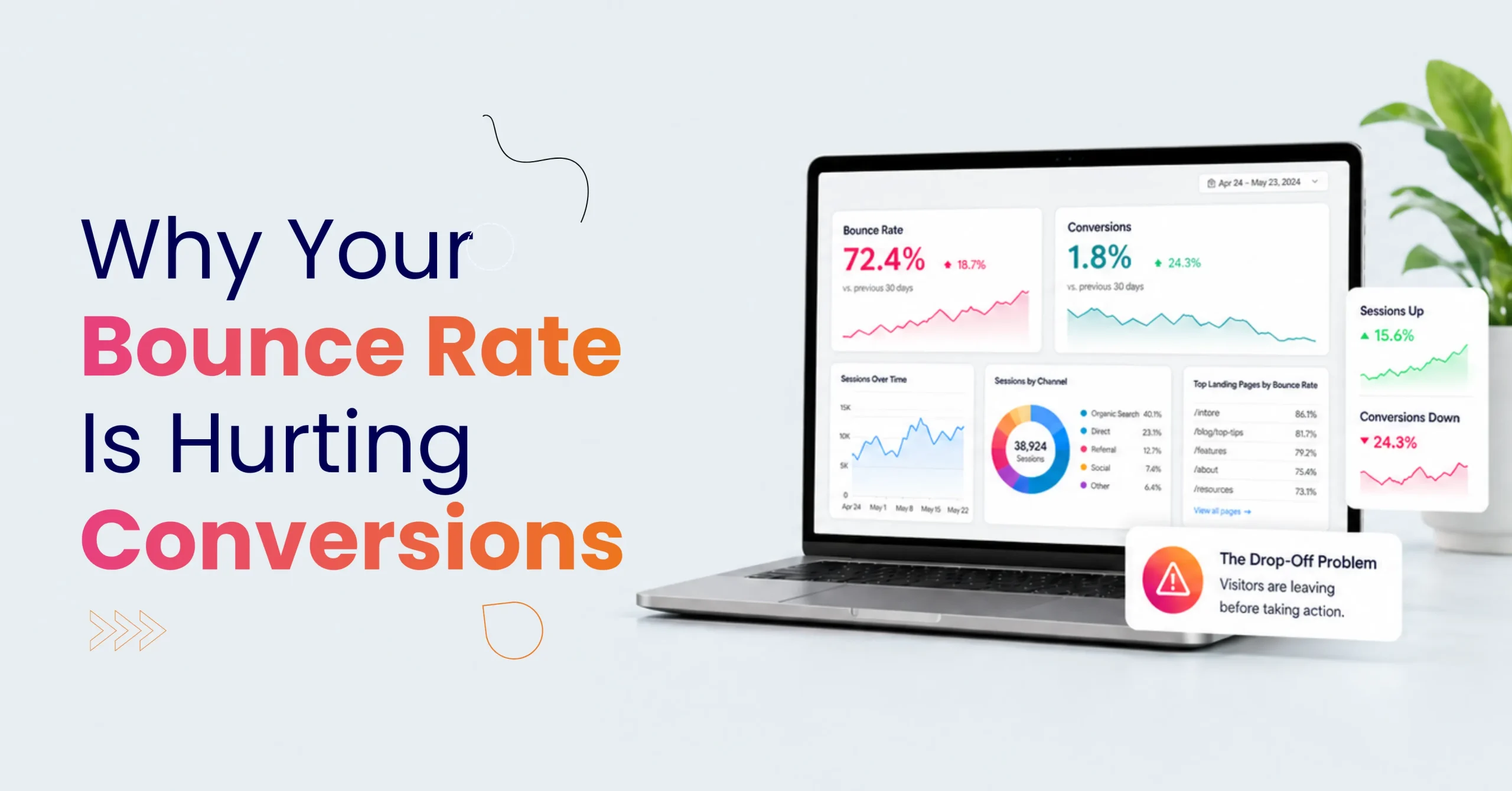

Your business boasts an ultra-modern, sleek website with all the features, including the latest AI-powered animation effects. Furthermore, those who visit your website are awestruck by your website design, scroll for some time, and leave without taking any action.
Then you should realize that there is a serious problem to fix on your website. However, it’s a huge relief to know that you need not build a completely new website, though.
When a website is not generating leads, the problem is a chain of conversion issues involving traffic quality, unclear messaging, CTA problems, trust, or form friction.
Most lead leaks can be fixed without rebuilding the site.
Not sure where visitors drop off? Request a website audit to uncover conversion barriers, tracking gaps, and priority fixes.
Table of Contents
Why Is Your Website Not Generating Leads?
Your website is probably not generating leads because the right visitors are not reaching it, or the page does not give them enough clarity, confidence, and convenience to act.
Strong website lead generation depends on qualified traffic, a relevant offer, an easy next step, and accurate conversion tracking. Identify where that journey breaks before changing the design.
What Do Common Website Lead Leaks Look Like?
| Symptom | Likely Cause | Priority Fix |
| Traffic increases, but inquiries stay flat | Traffic does not match buyer intent | Review keywords, campaigns, and align landing pages with search intent |
| Visitors leave service pages quickly | Unclear or weak value proposition | Rewrite the headline to focus on the customer’s problem and desired outcome |
| Users scroll but do not click | CTA is weak, vague, or hard to find | Add a clear, specific CTA above the fold (e.g., “Get a Quote,” “Book a Call”) |
| Forms are started but not submitted | Form feels too long or unclear | Reduce fields and explain what happens after submission |
| Mobile traffic converts poorly | Poor mobile UX (speed, layout, usability) | Improve page speed, button size, spacing, and form experience |
| Leads seem inconsistent or unreliable | Incomplete or inaccurate tracking | Set up tracking for calls, form submissions, and booked meetings |
Are You Attracting Traffic That Can Actually Convert?
More website traffic doesn’t guarantee more leads. Traffic quality matters because visitors arrive with different levels of intent.
Someone searching “what is conversion rate optimization?” is researching. Someone searching “website conversion audit for a small business” is closer to taking action. Sending both visitors to one generic page creates a search intent mismatch.
Review traffic by source, query, landing page, location, and device. Confirm that each page fulfills its search or ad promise, campaigns target potential buyers, service pages target high-intent keywords, and local visitors reach the service-area page.
Keyword research should support the buyer journey, not search volume alone.
Does Your Value Proposition Give Visitors a Reason to Stay?
Visitors should quickly understand what the business offers, who it helps, and why the offer deserves attention.
“Solutions for modern businesses” says very little. “Conversion-focused websites for US service businesses that need more qualified inquiries” provides immediate context.
A strong opening combines a customer problem, clear solution, believable outcome, supporting proof, and one primary action. Clarity often improves website conversions faster than adding more content.
Are CTA Problems Making the Next Step Easy to Miss?
A call to action should explain what visitors need to do and what they will receive. Generic labels such as “Learn More” or “Submit” create uncertainty.
Use specific copy:
- Get My Website Audit
- Review My Landing Page
- See Web Design Options
- Book a Strategy Call
Place the main CTA above the fold, after an important proof section, and near the conclusion. The goal is not to cover every screen with buttons. It is to provide a relevant next step when visitors are ready.
“Book a call” sounds like a commitment. “Discuss what is blocking your leads” gives the conversation a purpose.
Explore Varun Digital Media’s website design services to improve messaging, mobile usability, CTA flow, and conversion paths.
Is Form Friction Stopping Qualified Prospects?
Forms fail when they ask for too much, too soon. Every unnecessary field adds effort and another reason to leave.
For an initial inquiry, a name, business email, phone number, and short project field may be enough. Collect detailed requirements later.
Remove nonessential fields, use clear labels, improve mobile controls, show useful errors, and explain the response process. Test the confirmation page, notification email, and CRM delivery. The best form asks only what the team needs to qualify and respond.
Does Your Website Build Enough Trust to Earn an Inquiry?
Visitors act when the business appears capable, credible, and safe to contact.
Useful trust signals include current testimonials, customer reviews, case studies, relevant experience, team expertise, certifications, recognizable clients, clear contact details, privacy language, and completed-work examples.
Place proof close to important claims. Show the process, evidence, or outcome supporting each promise instead of hiding all social proof on a separate page.
For more guidance on matching content, search intent, CTAs, forms, and proof, review these SEO landing page tips.
Are Slow Speed and Weak Mobile UX Reducing Leads?
A slow or unstable page creates hesitation before the offer has a chance to work. Google’s Core Web Vitals guidance evaluates loading performance, responsiveness, and visual stability.
Improving website UX for leads requires more than passing a speed test. Mobile responsiveness requires readable text, stable layouts, visible buttons, simple navigation, and forms that work without zooming. Google also uses the mobile version of a site for indexing and ranking under mobile-first indexing.
Test the lead path on a real phone: open the page, understand the offer, tap the CTA, complete the form, use the phone link, and review the confirmation.
Can Visitors Find What They Need Easily?
Use plain navigation labels, give each service page one conversion goal, and connect related information through contextual internal links.
A natural page order is:
Problem → Solution → Benefits → Proof → Process → FAQs → Action
How Do You Fix Website Conversions Without Redesigning Everything?
Start with the highest-impact leak instead of changing the entire site at once.
- Verify tracking: Confirm calls, forms, meetings, and CTA clicks are recorded.
- Segment traffic: Compare results by channel, landing page, device, and location.
- Match intent: Align each page with the keyword, ad, or referral promise.
- Improve the first screen: Clarify the audience, problem, outcome, proof, and CTA.
- Remove friction: Simplify navigation, forms, mobile interactions, and page flow.
- Test one change: Compare focused updates to headlines, offers, CTAs, or forms.
Businesses using paid search should also review why Google Ads receive clicks without conversions. The issue may sit in targeting, message alignment, the landing page, or tracking rather than the budget.
What Should a Website Audit for Leads Include?
A practical website audit for leads should inspect the complete journey, not visual design alone.
- Traffic sources match the target audience and service area.
- Search intent aligns with each landing page.
- The headline communicates a clear value proposition.
- Primary and secondary CTAs serve distinct purposes.
- Trust signals appear near important claims.
- Forms request only necessary information.
- Mobile buttons, menus, and fields work comfortably.
- Page speed, Core Web Vitals, and technical website errors are reviewed.
- Calls, forms, and meetings are tracked correctly.
- Confirmation and follow-up processes work after submission.
For more on navigation, testing, and conversion behavior, see this guide to web design and user experience.
How Should a Website Lead Generation Strategy Be Measured?
Measure actions that move visitors toward revenue, not traffic alone.
Track qualified forms, calls, scheduled meetings, CTA click-through rates, form starts, completions, landing-page conversion rates, and lead quality by source. A high bounce rate may reveal a mismatch, but context matters. Judge each page by its purpose and user actions.
Also confirm leads reach the sales team with accurate source information. Broken attribution can make a productive channel appear ineffective.
When Is a Full Redesign Necessary?
Consider a redesign when structural problems affect navigation, mobile usability, forms, speed, accessibility, content management, or brand accuracy. When the foundation is sound, focused conversion optimization may be the better first move. Diagnose before rebuilding.
Final Thoughts
A lead-generating website attracts the right people, explains the offer clearly, earns trust, and makes action easy. Review traffic quality, message alignment, CTA problems, form friction, mobile experience, trust signals, and tracking. Fix the largest leak first, measure the result, and then address the next one.
Turn Your Website Into a Lead-Generating Machine
Find out exactly what’s blocking your conversions and fix it with a focused website audit.
Frequently Asked Questions
1. Why is my website getting traffic but no leads?
The traffic may not match buyer intent, or the landing page may have an unclear offer, weak CTA, insufficient proof, form friction, or tracking gaps.
2. What is the fastest way to fix website conversions?
Verify tracking, improve the first-screen message, strengthen the primary CTA, and remove unnecessary form fields.
3. How many CTAs should a website page have?
A page should have one primary conversion goal supported by contextually repeated CTAs. Secondary actions may help visitors who are not ready for the main commitment.
4. Does page speed affect website lead generation?
Yes. Slow loading, poor responsiveness, and unstable layouts weaken user experience. Core Web Vitals measure loading performance, responsiveness, and visual stability.
5. How often should a website audit for leads be completed?
Review core conversion paths quarterly and after major campaigns, design, service, or tracking changes. High-spend landing pages may need more frequent monitoring.
Published: July 13th, 2026
Tags:
- call to action optimization
- conversion funnel optimization
- conversion rate optimization
- CRO Strategy
- Form Optimization
- improve website conversions
- Landing Page Optimization
- lead generation strategy
- lead generation website
- website audit for leads
- website conversion issues
- website not generating leads
- website traffic vs conversions
- website UX for conversions