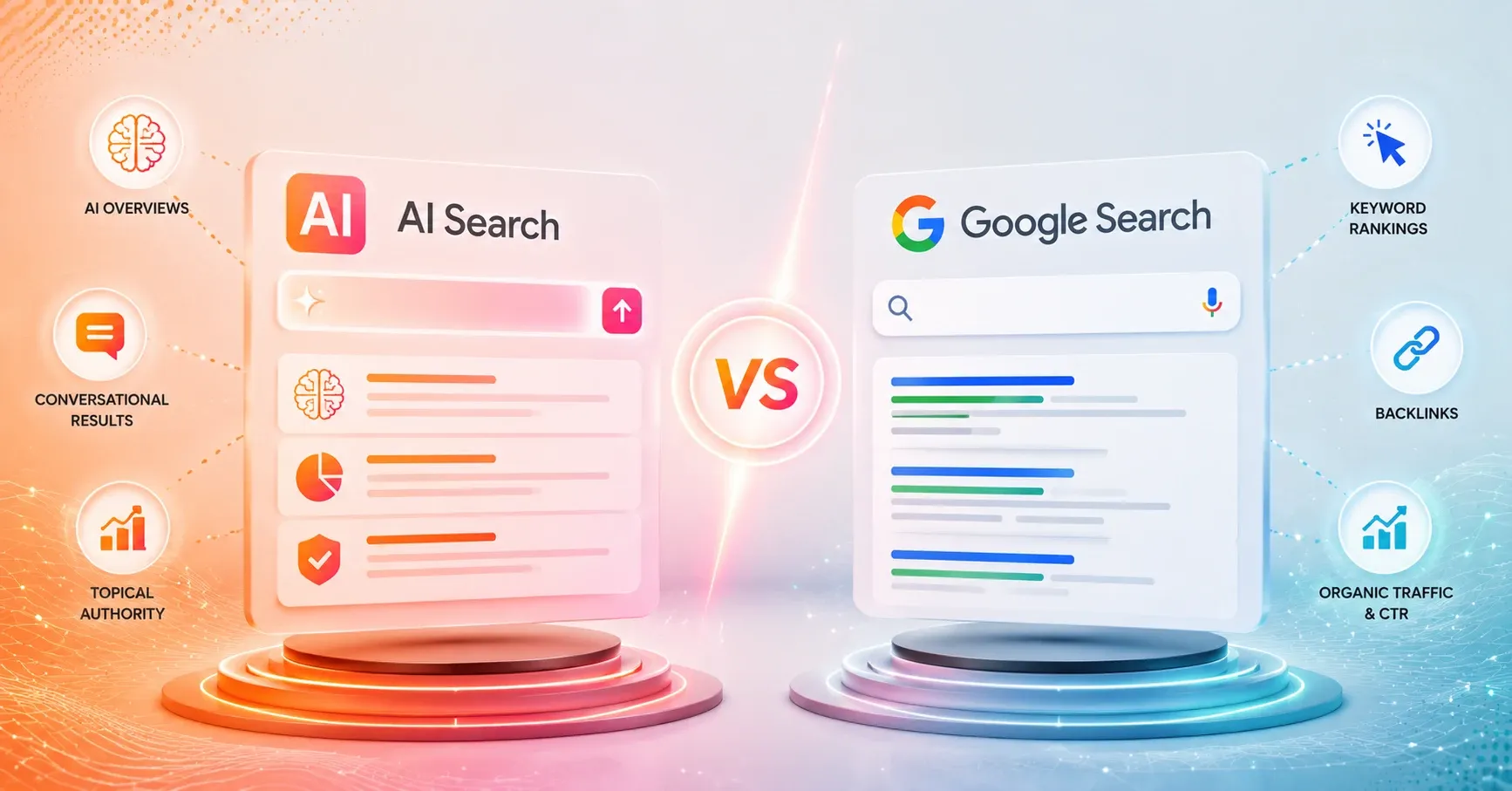
An AI visibility audit helps you measure whether your brand appears in AI-generated answers, how accurately it is described, and which sources are shaping that visibility. As search behavior shifts from link lists to answer-led discovery, brands need more than a standard SEO review. They need a reliable way to track mentions, citations, accuracy, and competitive presence across ChatGPT, Google AI Overviews, Gemini, Perplexity, and Claude.
A strong search presence still matters, but discovery now happens in a different way. Buyers ask full questions, compare providers inside one session, and form opinions before they ever visit a website. That changes what visibility means. If your brand is missing, misquoted, or framed through weak third-party sources, you are losing control of how prospects first understand your business.
This guide explains what an AI visibility audit is, how it differs from a standard SEO review, which metrics matter most, and how to turn your findings into a stronger search and brand growth plan.
Table of Contents
What Is an AI Visibility Audit?
An AI visibility audit is a structured review of how your brand appears across AI answer engines and AI-assisted search experiences. It looks at whether your business is mentioned, where it appears, what facts are attached to it, how accurate the framing is, and which sources the model relies on.
That matters because visibility now works in two layers. One layer is classic search, where rankings, impressions, and clicks still shape demand. The other layer is AI-led discovery, where buyers may read an answer, compare brands, and build trust before they ever visit a page.
A brand can still rank well and lose mindshare if AI answers rarely mention it. A brand can also be visible in AI search for the wrong reasons, which creates a different problem. You may appear through outdated reviews, weak summaries, or competitor comparison pages that frame your offer badly.
That is why a brand visibility audit should not be treated as an experimental side task. It belongs inside the same decision system as content planning, SEO, digital PR, and conversion strategy.
Turn AI Visibility Data Into Performance Metrics
Get a clearer view of mentions, source gaps, and answer quality before they affect trust and pipeline.
Why Traditional SEO Metrics Are No Longer Enough
Traditional SEO still gives useful signals. Rankings, impressions, branded search growth, page-level clicks, crawl health, and topical authority still shape whether your site is trusted. The issue is that they no longer tell the full story.
A page can gain impressions and lose clicks at the same time. A brand can have solid organic positions and still disappear from AI-generated answers for category queries. Another brand may not dominate the search results page, yet still get cited because its information is easier to extract, its messaging is repeated across trusted sources, or its pages answer buyer questions with more clarity.
That is where the gap opens. A normal SEO review asks if they are:
- Ranking?
- Getting traffic?
- Able to get the pages indexed and healthy?
The AI search audit asks if they are:
- being mentioned?
- cited?
- being described correctly?
- getting buyers to see the brand in answer-led journeys before they click anywhere?
That difference changes what you track, what you fix, and how you judge progress.
AI Visibility Audit vs Traditional SEO Audit
| Area | Traditional SEO Audit | AI Visibility Audit |
| Main Goal | Improve rankings, crawlability, and organic traffic | Improve mentions, citations, accuracy, and competitive visibility in AI-generated answers |
| Core Question | Are we ranking and getting clicks? | Are we being mentioned, cited, and described correctly? |
| Primary Metrics | Rankings, impressions, clicks, CTR, indexed pages, backlinks | Mention rate, citation frequency, share of voice, prominence, sentiment, accuracy |
| Main Platforms | Google Search, Bing, Search Console, rank trackers | ChatGPT, Google AI Overviews, Gemini, Perplexity, Claude |
| Main Risk if Ignored | Lower search traffic and weaker page performance | Brand absence, weak framing, outdated descriptions, competitor dominance in answer-led discovery |
| Business Impact | Organic growth through stronger SERP presence | Earlier vendor discovery, stronger brand recall, and better shortlist inclusion |
What an AI Visibility Audit Actually Measures
A useful AI visibility audit should focus on four practical dimensions.
Inclusion
This tells you whether your brand appears at all for the prompts that matter in your category. If a buyer asks for the best B2B email platform, local SEO agency, or enterprise content partner, your first question is simple: Are you present?
Prominence
This tells you where you appear inside the answer. Being named first carries more weight than being listed near the end. A passing mention is not the same as being presented as a recommended option.
Accuracy
This checks whether the answer is factually correct. AI systems may repeat old positioning, outdated pricing, incomplete product details, or broad category labels that no longer match your business.
Sentiment and framing
This looks at tone, context, and brand narrative. A neutral mention may still be weak if it strips away your advantage. A comparison answer may include your brand, yet frame another provider as the safer or more established choice.
If you track only one of these dimensions, you miss the picture. Inclusion without accuracy creates risk. Visibility without prominence creates weak recall. Mentions without the right framing do little for growth.
How to Define the Scope of an AI Visibility Audit
Before you start collecting outputs, define the audit scope. This is where many teams go wrong. They run random prompts, screenshot a few answers, and call it analysis. That does not create a repeatable baseline.
Your audit scope should define:
Platforms
List the engines you want to assess. In most cases, that includes ChatGPT, Google AI Overviews, Gemini, Perplexity, Claude, and Microsoft Copilot if your buyers use it.
Prompt groups
Split prompts into branded and unbranded sets.
Branded prompts include:
- What does [brand] do?
- Is [brand] a good option for mid-sized B2B teams?
- What are alternatives to [brand]?
Unbranded prompts include:
- Best AI SEO agency for SaaS brands
- How to improve AI search visibility
- Top tools for brand monitoring in AI search
Geography and language
If your audience is US-focused, keep prompts aligned with US English and US market terms. If your brand sells in multiple regions, segment those prompt sets instead of mixing them together.
Entities
Define what counts as your brand inside the audit. This may include the parent company, service lines, product names, executive thought leaders, proprietary frameworks, or branded methodologies.
This part matters because a weak scope produces weak findings. A clean scope gives you a baseline you can return to every month or quarter.
How to Run an AI Visibility Audit Step by Step
Once the scope is clear, the audit itself becomes much more manageable.
1. Build a prompt set that reflects buying behavior
Do not rely on abstract prompts. Use the questions buyers actually ask at the awareness, evaluation, and shortlist stages. This includes category terms, comparison prompts, vendor-selection prompts, and pain-point prompts.
2. Record brand mentions and citation patterns
For each prompt, log:
- whether your brand appears
- where it appears
- whether your site is cited
- whether third-party pages mentioning you are cited
- which competitors appear alongside you
This is where many early findings come from. Some brands show up mainly through third-party reviews. Others show up through their own blog content. Some barely appear at all except for branded queries.
3. Review the accuracy of each answer
Check whether the description is current, complete, and aligned with your positioning. Note every wrong claim, vague label, or missing differentiator.
4. Review sentiment and comparative framing
Does the answer place you in a strong light, a neutral one, or a weak one? Are you framed as a niche option, a premium option, a beginner option, or a secondary choice?
5. Map the source network
Which domains keep showing up in answers that mention your brand or your competitors? These sources often shape AI perception more than your owned site alone. That means your audit should include not just what AI says, but where AI learned to say it.
6. Turn findings into a visibility gap list
At this point, your brand visibility audit should reveal:
- prompts where competitors appear and you do not
- prompts where you appear but the framing is weak
- prompts where your own pages should be cited but are not
- third-party sources that influence the answer set
- pages on your site that need rewriting for extractability
How to Score Your AI Visibility Audit
A useful AI visibility audit should not stop at raw observations. It should produce a score you can track over time. A simple weighted model keeps the process practical.
Suggested scoring model
| Dimension | Weight | What it measures |
| Inclusion | 30% | Whether your brand appears at all for important prompts |
| Prominence | 25% | Where your brand appears inside the answer and how strongly it is positioned |
| Accuracy | 25% | Whether the answer reflects correct, current facts about your business |
| Sentiment and framing | 20% | Whether the answer presents your brand in a strong, neutral, or weak light |
How to score each dimension
Use a 1 to 5 scale for each prompt.
1 = poor
3 = average
5 = strong
Example interpretation
- 80 to 100: strong visibility and message control
- 60 to 79: visible, but with notable gaps in framing, consistency, or citation quality
- Below 60: weak inclusion or weak narrative control across important prompts
This scoring model helps you turn scattered AI responses into something comparable month after month.
Run a Smarter AI Visibility Audit With Varun Digital Media
Know where your brand stands in AI search and what to fix next.
What a Website SEO Audit AI Review Should Include
A website SEO audit AI review should go beyond technical hygiene. Yes, crawlability, indexing, schema, page speed, and internal linking still matter. But your pages also need to be easier for AI systems to parse, summarize, and cite.
That means reviewing:
- heading clarity
- direct-answer formatting
- structured summaries
- list formatting where appropriate
- comparison content quality
- first-paragraph clarity under each major section
- consistent entity language across service pages
- current facts, dates, pricing context, and proof points
This is where a standard technical audit and a content audit AI review should work together. The technical side helps engines access and trust your pages. The content side helps answer engines extract and reuse the right information.
SEO Audit Tools AI Teams Commonly Use
The strongest audits usually combine manual review with platform data.
Teams often blend:
- search performance platforms
- AI visibility monitoring tools
- brand mention tracking tools
- prompt logging sheets
- content scoring systems
- review monitoring platforms
That mix matters because no single dashboard shows the full picture. Some tools help with classic visibility trends. Others help with how to check AI mentions, compare AI outputs, or spot citation changes.
How to Check AI Mentions and Citation Quality
Knowing how to check AI mentions is one of the most practical parts of the process. This is where the audit moves from theory to evidence.
Start with a fixed prompt list and run it across the platforms in scope.
For every answer, capture:
- mention status
- position in the answer
- source cited
- whether the source is your site or a third-party domain
- accuracy of the description
- tone and buyer framing
Keep the format consistent every time you run the audit. That is what makes trend analysis possible.
You should also separate direct mentions from supporting citations. A brand can be named without being cited. A page can be cited without the brand being named clearly. Those are not the same thing, and they signal different problems.
If your site is cited but your brand is weakly framed, the issue is often messaging. If your brand is named but cited through third-party summaries rather than your own site, the issue is often owned-content weakness. If neither happens, your visibility gap is broader and usually requires work across content, authority, and distribution.
LLM Visibility Audit: What to Look for in AI Responses
A strong LLM visibility audit should not stop at mention counts. You also need to inspect the response pattern itself. Look for these signals:
Does the model understand your category correctly?
If your agency, platform, or service is placed in the wrong category, every follow-up answer gets weaker. A brand that should be seen as a strategic growth partner may get flattened into a generic vendor label.
Does the model connect your brand to the right use cases?
This matters for buyer intent. You want category prompts to connect your brand with the problems you actually solve, not just the broad sector you operate in.
Does the answer repeat your positioning or someone else’s?
Sometimes the AI answer reflects a competitor-written comparison page more than your own narrative. When that happens, the model may be using your name while reinforcing a competitor’s framing.
Does your differentiator survive the answer?
If the answer strips away what makes your offer distinct, then visibility exists, but persuasion does not.
These questions turn a broad AI search audit into something useful for growth planning.
What a Brand Visibility Audit Often Reveals
A proper brand visibility audit usually surfaces one or more of these patterns.
- The first is invisibility in unbranded prompts. This is common when a brand has strong branded demand but weak category authority. Buyers who already know the company may still find it, while new buyers never see it during discovery.
- The second is dependence on third-party sources. Many brands are visible only through review sites, listicles, Reddit threads, or comparison pages written by others. That can still help inclusion, but it limits narrative control.
- The third is outdated descriptions. AI systems may repeat positioning from old service pages, old media mentions, or stale directory listings.
- The fourth is fragmented authority. One topic cluster may perform well, while another close buying-intent area has almost no visibility at all.
- The fifth is competitor narrative dominance. A competitor may appear in fewer answers than expected, but still frame the category more strongly because its content is cited first, summarized better, or repeated across multiple authority sources.
These are the kinds of findings that help you move from a reporting exercise to an action plan.
Search Engine Visibility Score and What It Really Tells You
A search engine visibility score can still help inside this process, but it should be treated as a support signal, not the final answer.
In most tools, the score reflects weighted ranking presence across a tracked keyword set. That gives you a directional view of your classic search strength. It does not tell you how AI systems describe your brand, which prompts mention of you, or whether answer engines cite your best pages.
Use the score for trend direction. If it rises alongside branded demand, stronger topical coverage, and better AI mention rates, that is useful. If it rises while AI inclusion remains flat, then you know the issue is not just classic discoverability.
This is why modern audits need both sides:
- classic search visibility
- AI answer visibility
One tells you how often you are seen in search results. The other tells you whether you are part of the answer before a click even happens.
Want to Know How AI Search Sees Your Brand?
Find out where your brand appears, what AI tools say about it, and where competitors are winning attention.
How to Check Search Visibility of a Website Without Missing What Matters
If you want to know how to check the search visibility of a website, keep the process simple and layered.
Layer one- ( Google Search Console )
Use it to review impressions, clicks, query spread, and page-level movement for key topics and money pages.
Layer two ( rank tracking)
This helps you see directional movement across your tracked keyword portfolio.
Layer three ( AI answer testing )
This shows whether category prompts, shortlist prompts, and comparison prompts include your brand.
That three-layer system gives a much cleaner picture than any one report on its own. It helps you answer three practical questions:
- Are people seeing us in traditional search?
- Are the right pages carrying that visibility?
- Are answer engines mentioning us before users ever click?
That is the operational way to check website visibility now.
How to Interpret Moz Visibility Score and Similar Metrics
Teams often ask how to interpret Moz visibility score or similar numbers from other platforms. The answer is simple. Read them as momentum indicators.
They are useful for:
- spotting broad gains or declines
- checking whether a content refresh improved topic visibility
- seeing whether your tracked keyword set is strengthening over time
They are weaker for:
- explaining exact revenue changes
- judging AI answer inclusion
- identifying narrative quality or citation authority
In other words, they belong in the audit, but they should not lead the audit.
SEO Performance Audit Tools and AI Visibility Tracking
Most teams now need both SEO performance audit tools and AI-specific monitoring inside the same workflow.
Your SEO stack helps you understand:
- crawl health
- ranking direction
- page-level performance
- keyword spread
- branded and unbranded search growth
Your AI tracking workflow helps you understand:
- mention rate
- citation frequency
- response framing
- answer accuracy
- source dominance
- platform-specific gaps
That combination is where the strongest insights come from. Without the classic layer, you miss the foundation. Without the AI layer, you miss how buyers are increasingly forming vendor opinions.
How to Benchmark Your Brand Against Competitors
Competitor review is one of the most useful parts of an AI visibility audit, as long as it stays focused. Do not benchmark everything. Benchmark what changes your next move. Look at:
Prompt coverage
Which competitors appear for your high-intent category prompts, even when you do not?
Citation source overlap
Which review sites, publications, communities, or resource pages get cited repeatedly when competitors are recommended?
Content format dominance
Are AI systems leaning on comparisons, checklists, definitions, case studies, product pages, or review roundups in your space?
Narrative strength
Does the competitor own a stronger phrase, category label, or business problem in answer-led discovery?
Page readiness
Which competitor pages are clearly designed for extractability, comparison, and summarization?
This kind of benchmarking usually leads to much better action than broad competitor reporting. It tells you where to publish, what to rewrite, and which authority surfaces deserve outreach.
What to Do After the Audit
The audit is only valuable if it changes execution. For most brands, the next step falls into five workstreams.
1. Fix accuracy and consistency gaps
Update pages, schema, summaries, product descriptions, service descriptions, author bios, and profile listings. Clean entity language matters more than most brands realize.
2. Rewrite priority pages for extractability
Start with the pages that should be cited for category prompts, shortlist prompts, and high-value comparisons. Strengthen headings, first-sentence answers, lists, proof points, and short supporting sections.
3. Build pages that answer buying-stage questions
If competitors keep appearing in prompts such as “best,” “top,” “versus,” “how much,” or “which is right for,” then you likely need better buyer-stage content around those intents.
4. Strengthen third-party authority signals
If AI systems keep citing third-party pages, then digital PR, review generation, analyst mentions, community presence, and thought-leadership placements should become part of your visibility work.
5. Create a repeatable review cycle
Run the same audit monthly or quarterly. Keep the same prompt sets for baseline comparison, then add new prompts as products, services, and market conditions evolve.
Common Mistakes Brands Make During an AI Search Audit
Several mistakes keep showing up when companies run an ai seo audit for the first time. Some of those mistakes are-
- Treating AI visibility like a keyword-ranking problem only. Rankings still matter, but they do not explain inclusion, framing, or answer accuracy on their own.
- Testing only branded prompts. That creates a false sense of strength. Most growth opportunities live inside unbranded discovery prompts.
- Focusing on the mention counts without reading the answers closely. You can be mentioned often and still be framed weakly.
- Ignoring third-party sources. Many brands spend all their effort on owned content, while the actual answer set is being shaped by directories, comparison articles, industry roundups, and community discussions.
- Having no owner. This work sits between SEO, content, analytics, PR, and brand. Without clear ownership, findings stay inside a slide deck and never shape execution.
How AI Visibility Connects to Revenue and Brand Strength
This is where the audit becomes a business conversation instead of a content one. A strong AI visibility audit can support revenue in three ways.
- Earlier inclusion in vendor discovery- If buyers see your brand during category evaluation, you enter the decision set sooner.
- Cleaner market positioning- If AI systems repeat the right message about your offer, buyers arrive with less confusion and stronger initial trust.
- Compounding recall- Repeated mentions across classic search, AI answers, reviews, and authority sites create recognition long before the buyer fills out a form.
That matters because brand growth rarely starts at the click. It usually starts at repeated exposure, then moves into recall, then preference, then action. Visibility is the front edge of that chain.
Why Varun Digital Media Treats AI Audits as a Growth System
At Varun Digital Media, we do not look at AI visibility as an isolated search trend. We treat it as a strategic layer inside digital brand growth.
That means the audit should connect to:
- organic search performance
- content restructuring
- brand narrative control
- review and authority building
- internal linking and page prioritization
- conversion path strength after the click
A visibility report without execution value is just documentation. A strong audit should show where your brand is weak, where your competitors are winning, and which updates can improve discovery, recall, and conversion together.
Conclusion
An AI visibility audit helps you answer a bigger question than whether your pages rank. It shows whether your brand is being discovered, cited, and described properly in the places where buyer opinions are increasingly formed.
That is the real shift. Search used to be centered on winning the click. Now it is also about winning the answer. Brands that only track rankings will miss how AI-led discovery changes recall, comparison, and shortlist behavior. Brands that run a disciplined LLM visibility audit, improve extractable content, strengthen third-party authority, and review answer quality over time will build a much stronger position.
If your business is serious about category growth, this should move from an occasional review to a repeatable operating process..
Run a Smarter AI Visibility Audit With Varun Digital Media
Find where your brand is missing, misframed, or under-cited across AI search.
Frequently Asked Questions
1. What is an AI visibility audit?
An AI visibility audit is a structured review of how your brand appears across answer engines such as ChatGPT, Google AI Overviews, Gemini, Perplexity, and Claude. It checks mentions, citations, accuracy, sentiment, and source influence so you can understand how AI systems represent your business.
2. How is an AI visibility audit different from a normal SEO audit?
A normal SEO audit focuses on rankings, indexing, technical issues, and traffic. An AI visibility audit adds another layer by checking whether your brand appears in AI-generated answers, how it is framed, and which pages or third-party sources influence those answers.
3. How do I check AI mentions for my brand?
To check AI mentions, use a fixed prompt set across the major AI platforms and log whether your brand appears, where it appears, and which sources are cited. You can combine this with AI monitoring platforms and your search stack for a stronger baseline.
4. What should a website SEO audit AI review include?
A website SEO audit AI review should include technical SEO checks, structured data review, heading clarity, direct-answer formatting, page summaries, internal linking, entity consistency, and content freshness. It should help both search engines and answer engines understand your pages more clearly.
5. How often should I run a brand visibility audit?
For most brands, a quarterly review is a strong starting point. If your market is competitive, your category is moving quickly, or AI answer visibility is already part of demand generation, monthly checks are more useful.
6. Which pages should I prioritize after an AI search audit?
Start with pages that support high-intent category prompts, shortlist prompts, comparison prompts, and conversion-stage questions. These usually include service pages, product pages, comparison pages, proof-driven guides, and strong industry resource pages.
Published: June 9th, 2026