For years, SEO reporting was built around a familiar set of numbers.
Rankings. Impressions. Clicks. CTR. Organic traffic. Leads. Conversions.
Those numbers still matter. Google Search is still a major discovery channel, and marketers cannot ignore traditional SEO metrics. But search behavior is changing. People now use ChatGPT, Gemini, Perplexity, Google AI Overviews, and AI Mode to ask detailed questions and get direct answers.
That changes what marketers need to track.
The old SEO question was:
“Where do we rank on Google?”
The new question is:
“Are we mentioned, cited, trusted, and described correctly in AI search?”
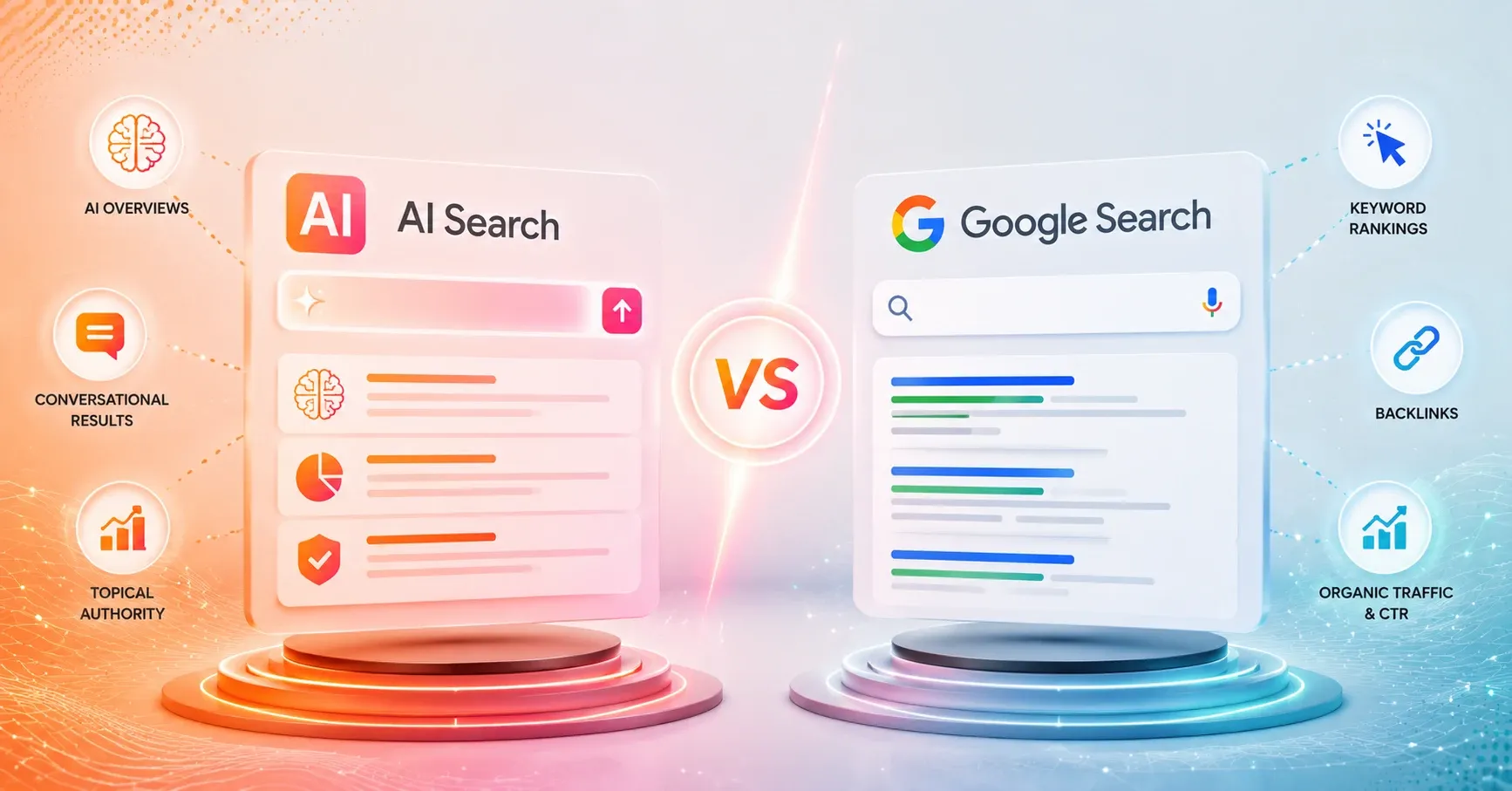
That is the real difference between AI search vs Google search.
Google Search usually sends users to a list of results. AI search often creates an answer before the user clicks anything. So marketers need to track both page visibility and brand visibility.
Table of Contents
What Is Google Search?
Google Search is the traditional search experience where users type a keyword or question and see results.
For example:
- Best SEO agency for small business
- AI search optimization services
- How to improve organic traffic
- Google vs ChatGPT SEO
Google may show organic listings, ads, featured snippets, People Also Ask results, local packs, videos, images, and AI Overviews.
For marketers, Google Search tracking usually includes:
- Keyword rankings
- Search impressions
- Organic clicks
- CTR
- Average position
- Organic traffic
- Backlinks
- Landing page performance
- Conversions
These metrics still matter because users continue to search, compare, click, and convert through Google. A strong Google SEO foundation also helps AI systems understand your site, content, brand, and authority.
But Google is no longer the only place where search decisions happen.
What Is AI Search?
AI search gives users a generated answer instead of only showing a list of links.
A user may ask:
“What should marketers track differently in AI search?”
“Which SEO agencies understand AI search analytics?”
“How is SEO different for Google Search and ChatGPT?”
The AI system may summarize information from many sources, mention brands, cite websites, compare options, and suggest next steps.
This is where Google vs chatgpt seo becomes important.
In Google SEO, the goal is usually to rank high enough to earn a click. In AI search, the goal is to be included in the answer, cited as a source, or recognized as a relevant brand.
That means marketers need to track whether their brand appears in AI-generated answers, not only whether their pages rank.
AI Search vs Google Search: The Main Difference
Google Search gives users options.
AI search gives users an answer.
That one difference changes the reporting model.
With Google Search, your website gets a chance after the user clicks. With AI search, the platform may compare brands before the user visits any website. If your brand is not mentioned, the user may never consider you.
This is why marketers cannot rely only on keyword ranking reports.
A page may rank well on Google and still be missing from AI answers. Another brand may not rank number one, but it may appear often in AI responses because it has strong mentions, clear positioning, third-party citations, and helpful content.
So the question is not SEO vs AI search.
The real question is:
“How do we measure visibility across both?”
Why Same Metrics Do Not Work for Both
Traditional SEO reporting is built around clicks.
AI search reporting is built around presence.
Google Search asks:
- Did the page rank?
- Did users see it?
- Did they click?
- Did the click convert?
AI search asks:
- Was the brand mentioned?
- Was the website cited?
- Was the brand described correctly?
- Which competitors appeared?
- Which sources influenced the answer?
- Did the answer reduce the need for a click?
This is where the zero-click search impact becomes important.
A user may see your brand in an AI Overview, read the summary, and search your brand later. That may not show as a direct organic click from the original query. If you only measure clicks, you may miss the value of AI visibility.
Search Engine Comparison AI: How the User Journey Changes
The classic Google journey looks like this:
Search → view results → click website → compare options → contact or buy
The AI search journey often looks like this:
Ask question → read summarized answer → see recommended brands → click only if needed
This affects how users research products and services.
They may not search:
“SEO agency pricing”
They may ask:
“Which type of SEO agency should a SaaS startup hire if it needs content, technical SEO, and AI search visibility?”
That is a different behavior.
AI search behavior is more conversational, specific, and comparison-led. Users ask follow-up questions. They expect context. They may ask for pros, cons, pricing, alternatives, and recommendations in one conversation.
That means marketers must track keywords and prompts together.
What Still Overlaps Between SEO and AI Search?
AI search does not remove the need for SEO.
A weak website, unclear content, poor internal linking, and thin authority can hurt both Google Search and AI search.
The basics still matter:
- Crawlable pages
- Clear page structure
- Helpful content
- Fast-loading pages
- Mobile usability
- Accurate metadata
- Schema markup
- Strong internal links
- Topic depth
- Consistent brand information
- Quality backlinks and brand mentions
The difference is in reporting.
Google Search shows how your pages perform in search results. AI search shows whether your brand is understood, mentioned, cited, and trusted inside generated answers.
What Marketers Should Track in Google Search
Google Search metrics remain the base of SEO reporting. Marketers should continue tracking these carefully.
1. Keyword Rankings
Rankings show whether your pages are visible for target searches.
Track:
- Primary keyword rankings
- Long-tail keyword rankings
- Local keyword rankings
- Branded and non-branded terms
- Competitor movement
- Ranking changes after content updates
But rankings should not be read alone. A page can hold position while clicks fall because AI Overviews, ads, or other SERP features reduce attention.
2. Search Impressions
Impressions show how often your page appears in search results.
If impressions rise but clicks do not, the page may be visible but not earning attention. It may also mean users are getting answers directly from AI summaries, featured snippets, or other SERP elements.
Track impressions by query, page, country, device, and date range.
3. Organic Clicks and CTR
Clicks show website visits from search. CTR shows how well your listing turns visibility into traffic.
If CTR drops while rankings stay stable, review:
- AI Overview presence
- Ads above organic results
- Featured snippets
- Competitor titles
- Meta descriptions
- Search intent mismatch
- Outdated content
CTR is no longer only a title tag metric. It is also affected by search layout.
4. Organic Conversions
Traffic is not the final goal.
Track what users do after landing on the site:
- Form submissions
- Calls
- Demo requests
- Purchases
- Downloads
- Chat interactions
- Assisted conversions
A smaller volume of traffic can still produce better results if users arrive with stronger intent.
5. Landing Page Performance
Track which pages bring qualified traffic.
Look at engagement, conversion rate, scroll depth, internal clicks, exit patterns, and assisted conversions. This helps identify pages that rank but do not support business goals.
What Marketers Should Track in AI Search
AI search analytics need a different set of metrics. These are the most important ones to add.
1. Brand Mentions in AI Answers
The first AI search metric is simple:
Does the AI mention your brand?
Test prompts such as:
- What are the best SEO agencies for AI search visibility?
- Which companies help with Google vs ChatGPT SEO?
- What agencies offer AI search analytics?
- Who helps brands reduce zero-click search impact?
Track whether your brand appears, how often it appears, and how it is described.
This is the AI version of ranking visibility.
2. Citation or Source Inclusion
AI answers may cite websites, blogs, reports, comparison pages, or third-party sources.
Track whether your website is being used as a source.
Check:
- Is your blog cited?
- Is your service page cited?
- Are competitors cited instead?
- Are third-party mentions cited?
- Which page types get cited most often?
- Are outdated pages being cited?
Citation visibility matters because it builds trust even when clicks are limited.
3. Prompt-Level Visibility
Keyword tracking is not enough for AI search ranking.
AI users ask longer questions. Marketers should convert target keywords into prompts.
Example:
Keyword: AI search analytics
Prompt: “What AI search analytics should a B2B marketing team track?”
Keyword: SEO vs AI search
Prompt: “How should a SaaS company change SEO reporting for AI search?”
Keyword: search engine future
Prompt: “How will AI search change SEO dashboards for marketers?”
This helps you track how your brand appears in real AI search behavior.
4. Competitor Share of Voice
In Google Search, you track who ranks above you.
In AI search, track which competitors are mentioned more often.
Measure:
- Which brands appear most often
- Which brands are recommended first
- Which brands are cited
- Which brands are described positively
- Which sources support them
- Which prompts show competitors but not your brand
This shows where your brand is missing from AI-led discovery.
5. Brand Description Accuracy
Being mentioned is not enough.
AI systems may describe your brand incorrectly. Track whether AI answers correctly mention your services, location, audience, industry, positioning, and strengths.
If AI calls your company a general marketing agency when you want to be known for SEO, PPC, content, and AI search visibility, that is a signal issue.
6. Sentiment and Trust Signals
Track the tone around your brand.
Is the brand described as trusted, relevant, experienced, specialized, generic, unclear, or outdated?
AI-generated answers often reflect the quality of available information across your website and external sources. Negative, vague, or inconsistent signals can weaken brand visibility.
7. Third-Party Source Influence
AI systems may rely on sources beyond your own website.
Track which external sources influence answers:
- Review platforms
- Directories
- Industry blogs
- Digital PR articles
- Comparison pages
- Guest posts
- Forums
- Reddit threads
- LinkedIn posts
- Partner pages
This matters because your reputation outside your website can affect whether AI systems mention or trust your brand.
8. AI Overview Visibility in Google
Google Search now includes AI features for many queries.
Track:
- Which target queries trigger AI Overviews
- Whether your site appears as a supporting link
- Whether competitors appear
- Whether clicks fall when AI Overviews appear
- Whether impressions rise but CTR drops
- Which page types appear in AI features
This connects traditional SEO data with AI search ranking visibility.
9. Mention-to-Click Gap
AI search may mention your brand without sending traffic.
So track:
- AI mentions
- AI citations
- Referral visits from AI platforms
- Branded search growth
- Direct traffic changes
- Assisted conversions
This gives a more realistic view of AI search value. Visibility may happen before the website visit.
10. Conversion Quality From AI Traffic
AI search traffic may be lower in volume, but users can be more informed when they click.
Track:
- Lead quality
- Time on page
- Pages per session
- Form completion rate
- Demo requests
- Sales-qualified leads
- Assisted conversions
Do not judge AI search only by traffic volume. Judge it by visibility, trust, and qualified demand.
AI Search vs Google Search: Tracking Comparison
| What to Track | Google Search | AI Search |
| Visibility | Keyword rankings | Brand mentions in AI-generated answers |
| Demand | Keyword search volume | Prompt trends and topic demand |
| Performance | Impressions, clicks, and CTR | Mentions, citations, recommendations, and answer inclusion |
| Authority | Backlinks, referring domains, and domain authority | Brand mentions, citations, entity recognition, and source trust |
| Content Success | Ranking pages and organic traffic | Cited pages, extracted answers, and source references |
| Competition | SERP competitors | Brands and sources recommended by AI platforms |
| User Action | Click-throughs and website visits | Zero-click brand discovery, follow-up prompts, and assisted visits |
| Reporting Tools | Google Search Console, GA4, and rank trackers | AI visibility platforms, prompt monitoring, citation tracking, and manual AI testing |
| Main Risk | Ranking loss and traffic decline | Brand absence, inaccurate representation, or competitor dominance in AI answers |
| Business Value | Organic traffic, leads, and conversions | Brand recognition, trust, assisted conversions, and future buying influence |
Why Tracking the Same Keywords Still Helps
AI search uses different behavior, but keyword strategy still matters.
Search volume shows demand. If people search a topic on Google, they may also ask AI tools related questions.
So marketers should track the same keyword set across Google Search and AI search.
For example:
- AI search vs Google search
- AI search vs. Google search
- Google vs Chatgpt SEO
- AI search ranking
- Search engine comparison AI
- AI search behavior
- Zero-click search impact
- Search Evolution AI
- SEO vs AI search
- Search engine future
- AI search analytics
These keywords can be tracked in Google and converted into AI prompts.
This keeps reporting cleaner. You are not running two separate strategies. You are tracking the same demand across different discovery channels.
How to Build an AI Search Tracking System
Start simple.
Step 1: Build a Prompt List
Create prompts from target keywords, buyer questions, sales objections, and competitor comparisons.
Example:
Keyword: AI search analytics
Prompt: “What AI search analytics should a marketing team track in 2026?”
Keyword: google vs chatgpt seo
Prompt: “How is SEO different for Google Search and ChatGPT?”
Step 2: Test Across Platforms
Do not test only one tool.
Check Google AI Overviews, Google AI Mode, ChatGPT, Gemini, Perplexity, and Claude if your audience uses it.
Each system may use different sources and produce different answers.
Step 3: Record Brand Presence
For each prompt, record:
- Brand mentioned or not
- Position in the answer
- Competitors mentioned
- Sources cited
- Sentiment
- Accuracy
- Page cited
- Missing information
A spreadsheet is enough at the start.
Step 4: Compare With Google Search Data
For the same topics, compare Google rankings, impressions, clicks, CTR, AI mentions, AI citations, and competitor visibility.
This helps you see where Google visibility and AI visibility do not match.
Step 5: Improve the Source Signals
If AI systems cite competitors instead of your brand, check what sources support those answers.
You may need:
- Clearer service pages
- Better comparison content
- Direct answers in blogs
- More third-party mentions
- Stronger review profiles
- Digital PR coverage
- Better schema
- Consistent brand descriptions
- Updated business listings
AI visibility is often a source problem, not just a content problem.
Common Mistakes Marketers Make
i. Tracking Only Google Rankings
A brand can rank well and still be missing from AI answers. Rankings matter, but they are not the full view anymore.
ii. Measuring AI Search Only by Traffic
AI search often creates zero-click visibility. If you track only traffic, you may miss mentions, citations, and assisted demand.
iii. Ignoring Brand Accuracy
A wrong mention can create confusion. Check whether AI describes your services, location, audience, and positioning correctly.
iv. Testing Prompts Only Once
AI answers can change. Track patterns over time instead of reacting to one result.
v. Ignoring Third-Party Mentions
Your website is not the only source AI systems use. Directories, reviews, PR, forums, and comparison pages can influence AI answers.
vi. Treating AI Search as a Separate Silo
AI search and Google Search are connected. The reporting layer is different, but the strategy should support both.
What This Means for the Search Engine Future
The search engine future will not be only links or only AI answers.
It will be mixed.
Google will keep adding AI features. Users will keep using ChatGPT, Gemini, Perplexity, and other tools for research. Traditional rankings will still matter for local, transactional, navigational, and high-intent searches.
The role of marketers is to understand where discovery is happening.
Google Search is useful for traffic, rankings, and demand capture.
AI search is becoming important for brand discovery, product comparison, trust, and shortlist creation.
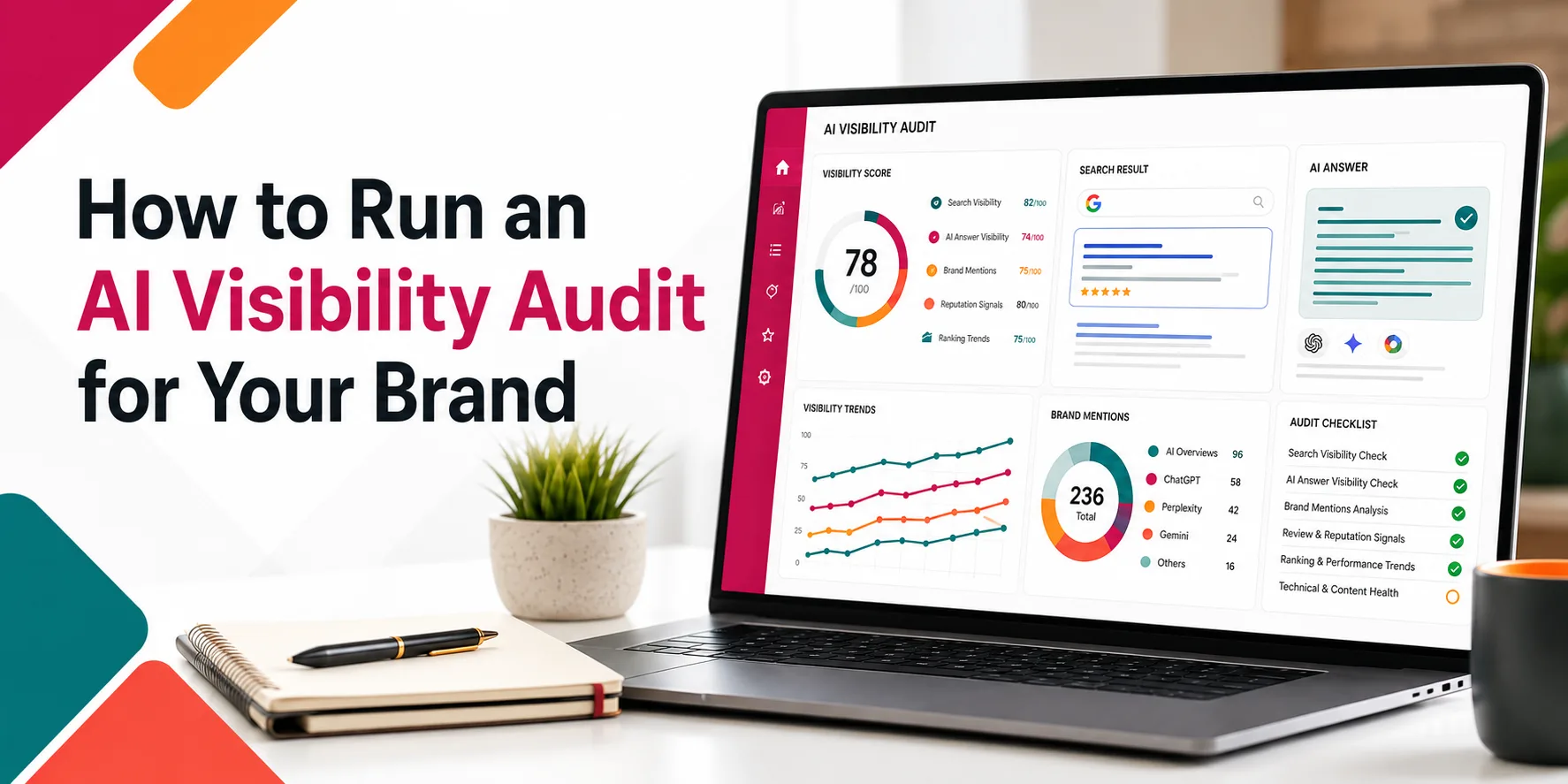
A modern search dashboard should show:
- Google keyword rankings
- Organic traffic
- Search Console performance
- AI Overview visibility
- AI brand mentions
- AI citations
- Competitor AI share of voice
- Brand description accuracy
- Third-party source influence
- Conversions and assisted demand
This gives marketers a clearer view of search evolution, AI, and how visibility is changing.
Final Thoughts
Google Search shows how your pages rank, earn clicks, and convert visitors. AI search shows whether your brand is mentioned, cited, trusted, and described correctly when users ask direct questions.
Marketers should keep tracking rankings, impressions, clicks, CTR, and conversions. But they should also add AI search analytics such as brand mentions, citation visibility, prompt-level visibility, competitor share of voice, sentiment, and source influence.
Search has moved from keywords alone to answers, sources, and brand trust.
Your reporting should move with it. We help businesses measure rankings, AI brand mentions, citations, and competitor visibility to build a complete search performance strategy.
Ready to Track Your AI Search Performance?
FAQs
1. What is the main difference between AI search and Google Search?
Google Search shows ranked results. AI search gives direct answers, so marketers must track brand mentions, citations, and visibility inside AI responses.
2. How is Google vs ChatGPT SEO different?
Google SEO focuses on rankings and clicks. ChatGPT SEO focuses on whether a brand is mentioned, trusted, and described correctly in AI-generated answers.
3. What AI search analytics should marketers track?
Track AI brand mentions, citations, prompt visibility, competitor share of voice, sentiment, source influence, and brand description accuracy.
4. How does zero-click search impact SEO reporting?
Zero-click search can reduce clicks, even when visibility is strong. Marketers should track mentions, citations, branded searches, and assisted conversions.
5. How does Varun Digital Media help with AI search visibility?
Varun Digital Media tracks SEO performance, AI mentions, citations, competitor visibility, and content gaps across Google and AI search platforms.
Published: June 30th, 2026